Friday, October 16, 2015

AAC Family Friday!

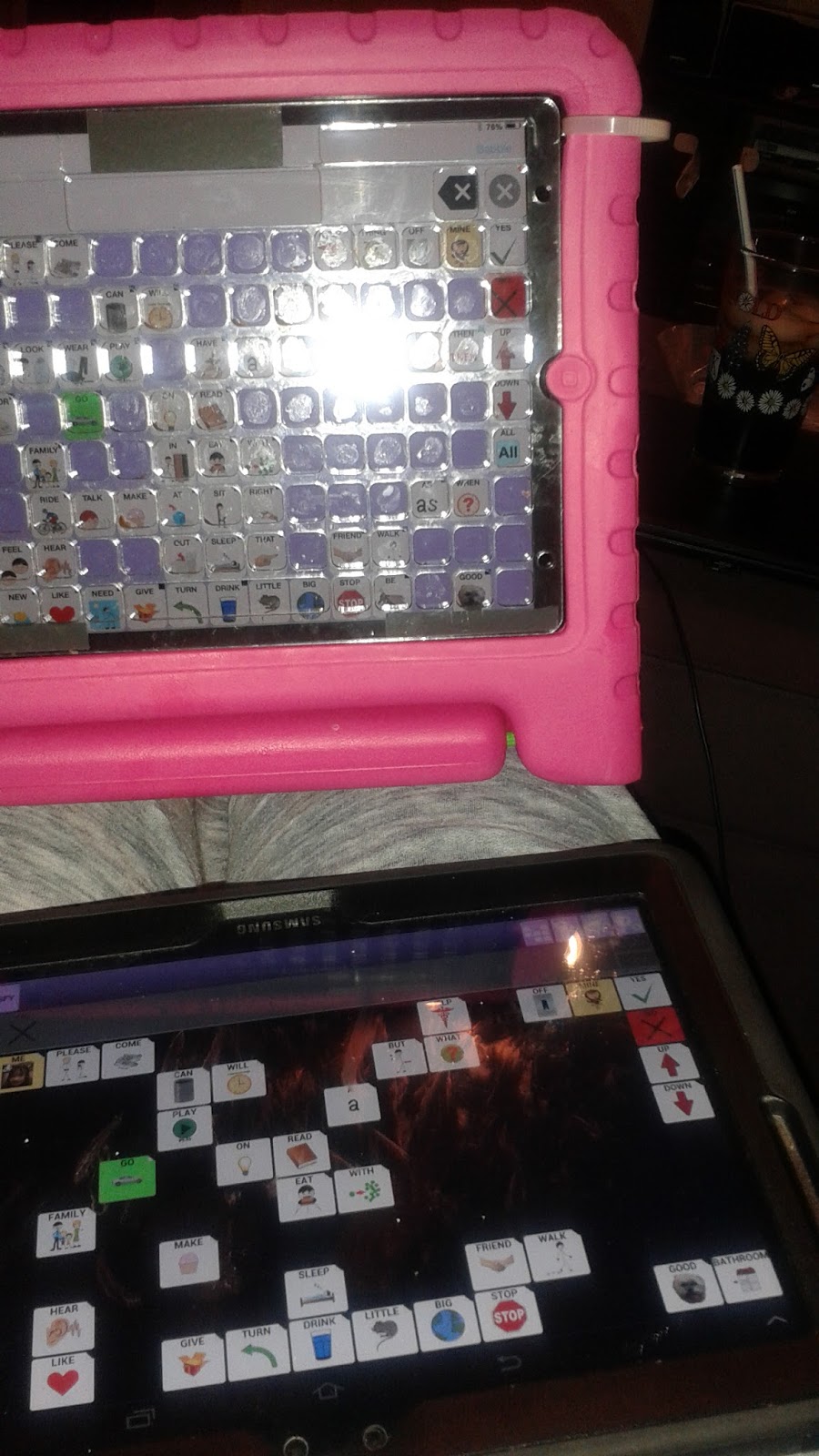
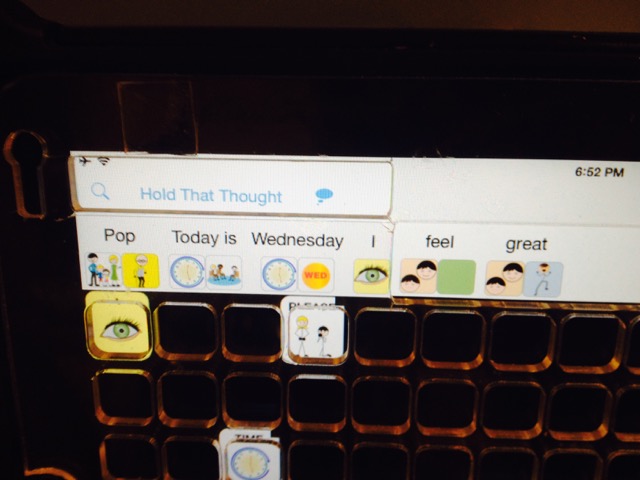
Happy AAC Family Friday! Thank you to all who have sent in pictures---I seriously love putting this together each week :) (The italicized text is quotes pulled from emails, the plain font stuff is my own commentary). 


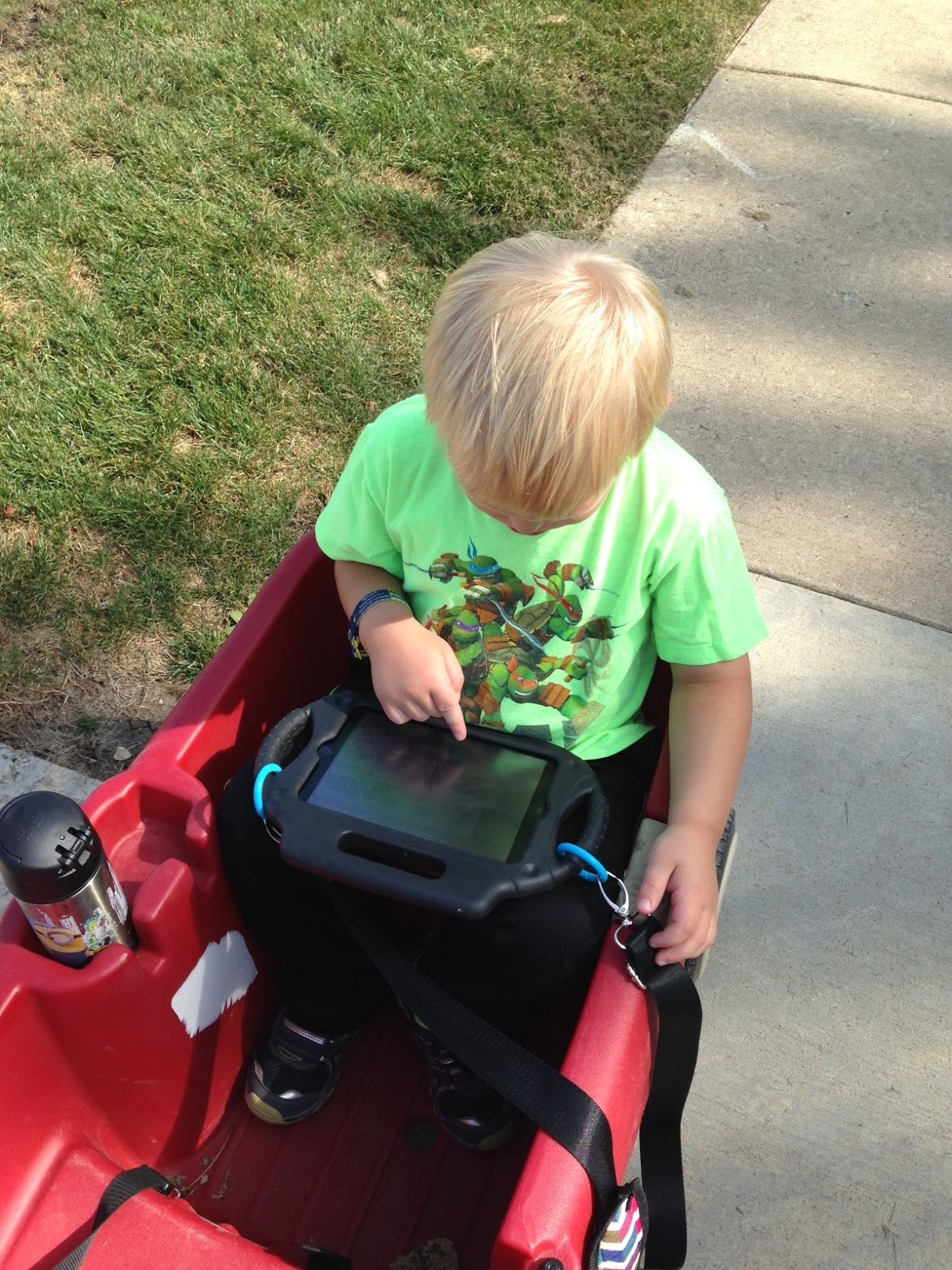
Here's Finn at the park, using his talker to chat about trucks we see on the bridge in the distance!


 Chatting with daddy with PODD, using the Compass app.


 Lemmy, 4 years old, using his iPad with speak for yourself while we shop. He loves to chat when we're shopping.


 C waiting patiently to see the ENT and commenting on a girl's sweatshirt - 'sparkles'. (It was pretty flashy) 


 Aidan with his talker at his brother’s cross country meet. His brother shattered the school record . . .


 . . . because Aidan was able to give him very clear instructions: LIAM RUN FASTER

Check out more of Aidan's adventures and his mom's reflections here: http://familysynapse.com/


 Hosea (age 5) chats during a break from his soccer game.


Avelina (age 3) enjoying the pumpkin patch.


 Hosea labels the animals in the petting zoo for his little sister.


Avelina uses her talker at mealtime.


Hosea and Avelina (of the four fantastic pictures above) both use Speak for Yourself on a ProSlate 8 (iPad mini). They also both have a rare genetic disorder called GAND (GATAD2B-Associated Neurodevelopmental Disorder).  You can read more about GAND at www.gatad2b.org or follow the Facebook page atwww.facebook.com/gatad2b.

This comes from the other side of our AAC family---the professionals! Taken at the "Closing the Gap" conference, this is Renee Collender (co-creator of Speak for Yourself), David Niemeijer (AssistiveWare CEO and founder), and Heidi LoStracco (co-creator of Speak for Yourself).


Max is FaceTime'ing with Grandma - a very motivating activity!   With the talker right next to the iPad, Grandma can hear. Max is learning to ask questions and comment. It's been awesome!
(And since Grandma is not in the home, it fits the theme!)


Alix communicating whilst canoeing.


(Canoeing, people!!!)


Tia (from Slovenia) in a vineyard, using communication binder (made with Boardmaker), discussing fall and fruits.


 (totally speaks for itself)


Aidan and I talking about what we are excited to see on the dolphin cruise we were on!


Jay (almost five) enjoying "local summer" in Long Branch, NJ on Columbus Day!


 Daddy helps find a word at the zoo!


After spotting a pinwheel in the garage before a walk, she was adamant we take it with us. I took a photo and added the word to her talker. It was a favorite word on the walk and in the weeks following!


Maya and her talker, laughing it up with the Count and his talker at Sesame Place!

Tuesday, October 13, 2015

Toss-it-back Tuesday: Maya Finds Her Voice

Don't be intimidated by the 10 minute timestamp on this video---once you start watching (it opens with 2 year old Maya signing "open" and making some noise) you kind of get pulled in.

This was put together for an assistive tech conference that we added two years ago, and it shows highlights from 3 years of Maya's AAC journey (age 2-5). While progress is real life is slow and sometimes inconsistent, this video gives the wide view on what AAC looks like with a new user.

(It also makes me think, "Oh man, I should be getting more video now, so that I can make a year 5-8 video next.")

Without further ado . . .  Maya Finds Her Voice.


2.5 years old and so cute! (Click the link above to get to the video)


Monday, October 12, 2015

Emailing with AAC (video)

Before I had kids I'm not sure that I would have predicted that I would be encouraging my child to start sending email as soon as possible . . . but that's definitely what happened. On a quest to encourage Maya to work on writing (writing = typing; and spelling things phonetically, or even typing strings of jibberish letters also = writing) I set up an email account for her well over a year ago . . . but it never really took off. She tried it out, but she wasn't much interested in trying to write anything intentional, and she lost interest after a few days of banging out (literally) some email.

At that was it, until last week.

Last week Maya's app (Speak for Yourself) sent out an update that allows the user to email from within the app. (This is awesome. Also, there are a few other apps that have similar functionality---so if you have a child/client using something different, check whether you have this option.) Now Maya can compose an email the same way she uses her app to speak, just by building sentences into the sentence bar, and then she can click to send them. It's been a game-changer.

Before I talk about how we're using email, here are a few logistics: 1. I deleted my email account and contacts from the iPad and then added Maya's email account and contacts, so that she only has access to a small number of family/friends to email. 2. We do email on a separate talker, not on Mini (this might change, but not right now). 3. I only turn on the email function for designated email times.


So, here's what email is doing for us---and what it's not. 

  • It's letting us work on narrative building. Conveying information has important parts, and if you leave information out the message gets muddy. It is strange to just say "Hi Grandma" and send that as an email. If you're writing to someone it should have a few sentences. If you say a few things about yourself, it's nice to ask a question so that your friend has something to respond to.
  • It's letting us work on punctuation (and eventually grammar) in ways that feel more natural than speech. Consider "be for Halloween" (something Maya actually wrote in an email yesterday): is it a statement (before Halloween let's do xyz, or I'm going to be something for Halloween) or is it a question (what are you going to be for Halloween?). For Maya, it turned out to be a question (I know because I asked her) so I showed her how to add a question mark. Using punctuation is a skill of composing stories that I don't really target when she uses AAC to communicate, because it feels strange to add punctuation to speech . . . but it feels natural when you're composing an email. 
  • Eventually, I will model some recasts of her grammatically incorrect sentences, but I am not doing that right now. I want writing email (or stories, or anything) to be fun---not to feel like work. I want her to feel successful and motivated. I may insert myself to add a punctuation mark (because that doesn't feel obtrusive) but I'm mostly sitting back (and just encouraging her to expand).
  • Emailing from within the app is not taking the place of other typing. It's fantastic that this gives her a way to work on writing skills (composing sentences and questions, telling stories, etc) but it doesn't take the place of using letters to spell phonetically. That phonetic spelling is what will lay the foundation for true literacy, and it needs to be included in her days (right now this is generally done at school---I'm not doing formal spelling work at home. Not due to lack of interest, but lack of time). You'll see in the video that she does sometimes incorporate spelling into her emails, which I am encouraging but not requiring or prompting. 

I thought it might be helpful to share a video of what it looks like when we sit to write an email. I was trying something new here, asking Maya to "tell 2 things and ask 1 question" in order to thwart her natural tendency to write a word or two and then send immediately. I'm intentionally not modeling any possible sentences because I want her to really generate the ideas on her own, not to copy something that I say. 

If you have ideas or feedback, I'd love to hear it :)


Friday, October 9, 2015

AAC Family, Week 2!

Happy AAC Family Friday, everyone!

I received a smaller crop of pictures this week (I blame myself for forgetting to promote it until Thursday morning---oops!) . . . but the ones that were sent it are fabulous :)

For next week, a theme: let's get a big post next Friday filled with our AAC users out and about. Your mission this week is to get a picture of AAC use outside of the home. Send your pictures to uncommonfeedback@gmail.com (and I promise to remind you guys on FB before Thursday).

Without further ado:

We were out on the weekend here in London and took this picture of Cady with her talker in a greenhouse. She was using it to tell me the colours of the different flowers we were looking at.


 Chatting with PODD. Anna 8 years old with Angelman Syndrome and we live in The Netherlands. Since May we use also the Compass app and I just love that our house is not so quite anymore.


Tia Sara has undiagnosed nevro- muscular genetical condition (probably Mitochondrial disease). She in 9,5 years old, and is using head switches with computer (SD) and iPad (app Go Talk NOW). This picture is Tia Sara choosing what she wants to do.  We are from Slovenia (Europe) where aac community isn't very large.

Nadomestna komunikacija/neverbalno sporazumevanje (a link to a Slovenian Facebook group):  https://www.facebook.com/groups/310899679098188/

And this is a link for Tia Sara's Facebook page: https://www.facebook.com/tiasara2006


 A screenshot from Nico (a 4 year old Speak for Yourself user who has Angelman Syndrome) asking his parents to take him swimming!


 One of Nico's younger brothers exploring AAC during a bath!


This is Finn!  He is 4 yrs old and has a rare chromosome deletion and global developmental delays.  In this pic he is using his talker (TouchChat on an iPad mini) to talk about what he sees on our daily after school walk to the park.  His favorite part of the day!


 Roo (age 5) at AAC themed camp (ALL the kids/adolescent campers used AAC devices with camp activities geared around fun using their devices) with her camp counselors that are SLP students. We live in Houston, camp was in Mississippi.


Milo and Lily Grace chatting with their PODD books during a play date in San Francisco, CA!


Charlie using PODD to cheer on his rugby team in the world cup!

Maya and Will waiting for Maya's bus in the morning. Maya is wearing Mini, an iPad mini in an iAdapter case, and uses Speak for Yourself. 


Thursday, October 8, 2015

Pulling Your Team Together

Whether you are the parent of a child with special needs or a professional (teacher, SLP, OT, PT, ATP, etc) working with children with special needs, you have likely disagreed with someone at some point over something related to goals and priorities and implementation. Maybe you’re annoyed that the classroom teacher is spending so much time on tracing when you think the child should be keyboarding, or you feel that the time devoted to learning to jump would be better used practicing ascending and descending stairs. Or maybe you feel like the school team is working like a well-oiled machine, but the family isn’t doing any carryover. The conflicts are fairly common, especially when a child is complicated and may have a large amount of team members jostling to direct their area of expertise.

We’ve been through this with Maya’s team over the years, many times. There are a large number of things that I let go (for example, I’m rarely involved with PT, as it’s just not my priority, and it’s the area in which I am least informed about goals and methodologies). I’m semi-involved in OT, mainly because I want her to have the skills needed to write (in whatever form that takes) and I check in periodically to ensure that the occupational therapist is remembering that that is our goal. But communication . . . well, I’m all over that one.

When there are family vs. professional (or professional vs. professional, or family vs. family) conflicts related to AAC choices, AAC implementation, the balance between AAC and other speech services . . . well, it can feel pretty emotional. Fostering an individual’s ability to communicate autonomously, to say exactly what they want to say, to whom they want to say it, whenever and wherever they happen to be----that’s as high stakes as it gets. If one member of a team feels that they have a plan for how to support the child in using AAC and another team member disagrees, or isn’t interested in trying, it feels like a very real threat to the child’s ability to become a communicator (and, truly, it often is a real threat).

Things get emotional. You-have-to and This-isn’t-how-we-do-it declarations are made. Heels are dug in. Invisible lines are drawn. People are defensive. The team is not a team, but loose collection of different people with different agendas who are teetering on the edge of not trusting or respecting each other.

No one wins.

I've been there, as a parent and as a teacher, and I imagine that in a few years I will be there as an SLP, too.  And for the past several years I’ve been in the slightly awkward position of being the AAC expert on Maya’s team, as well as her mom. As you may imagine, it has been uncomfortable to introduce myself to the new SLP each year . . . I have to walk in, teach them about Maya’s system, explain my goals (total communication goals, AAC goals, and speech goals), and give them a rundown of some AAC best practices. Sometimes I have to spend time gently informing them about motor planning, and why I won’t allow them to program or re-arrange vocabulary, and why topic boards aren’t really appropriate or a best practice. So basically Even though you are a professional and I’m the mom, I know more than you do about AAC, and I’m going to tell you how you need to use it, and actually some of the stuff you thought you were doing correctly aren’t really best practices anymore. Oh and hey, nice to meet you!

Awkward.

And then I do it with the teacher and para, too.

I’ve been pretty fortunate to have team members who listen, learn, and work together---and I’m sure that part of this is luck, but part of it is also the approach. As someone who has been a teacher and a parent, I can see that there is one underlying key to getting everyone to come together: investment. The team leader (in the example above that's me, since I was the person calling the meeting) has to get each member of the team invested in the matter at hand. It’s a central concept of leadership, I think: if people feel empowered, motivated, and valued they become excited to dive in and give it a go.  (Whereas if people feel uninformed, un-confident, and like demands are being placed on them, they become defensive and may be “forced” to comply, but their participation will be subpar, phoned in, and will likely fade quickly.) 


And so, here’s my approach. (Note: In this approach you have to presume competence and good intentions of the people on the team. Extra note: If you suspect your team member may not be competent or have the best intentions, put on a fake smile and try anyway.  If needed, when this fails you can move up the chain of command knowing you did your best----but they may end up surprising you.)


Step 1: What is happening here is amazing!!!!! In this step, you share what you are implementing and how it's working. Bonus points for having video clips of AAC use or AAC modeling in action, or work samples, or anything concrete that can catch the team member's eye and pique their interest. Some examples:
  • We are building a foundation of language by modeling without any expectation of him to use it in return, which will lead to his ability to share his thoughts when he is ready and able.
  • We are encouraging her to love and interact with the talker, which will sometimes be purposeful communication and will sometimes be noisy exploration, and this will lead to a greater knowledge and mastery of the vocabulary in the device.
  • We are responding to everything he taps as if it is purposeful and meaningful, which will lead to the understanding that we respect his use of this device as truly communicative and not “just playing.”
  • We are choosing to focus primarily on core vocabulary because it is highly useful and flexible, and using smaller amounts of fringe vocabulary right now while he is learning, which will lead to her ability to communicate about many things throughout the day, rather than just during circle time.
  • We are responding to “misuse” of the device the way that we would respond to “misuse” of speech, by using phrases like “right now isn’t a time for talking” or “we can talk about that topic during free time, but right now it’s time to discuss this story.”
  • We are attempting to increase her utterance length by recasting and expanding upon her statements throughout the day, which will help her to share more of her thoughts with all of us.


Step 2: You are uniquely poised to play a role in this amazingness, and it’s easy to see that you are going to do an amazing job being an amazing member of this amazing team! Some examples:
  • I can see how much you are invested in the success of your students, and I know that he really looks up to you!
  • Since he spends the bulk of his time in your classroom, the support that you can provide for him will have a huge impact.
  • As an SLP, you play such an important role in improving her communication, and analyzing the areas of language that we can target next!
  • During your sessions she will be able to really target and practice new skills in a way that she won’t be able to do in the larger classroom.
  • I’m only her teacher, and I am so excited to hear the new thoughts she will be able to share with this device----I can’t even imagine how exciting that must be to you, her parent.

Step 3: Don’t worry if this seems new-there are a lot of different ways that I can support you and we can work together to keep up the amazingness!  Some examples:

  • Let me show you a few things that are working for us. We’re really excited about them! 
  • I know that you have a lot on your plate. Let’s figure out how we can ensure that this is easy for you to implement (and doesn’t create much extra work)
  • Let’s identify a who/when/where/how for starting implementation (in a discreet way)
  • Let’s agree on a bottom line for these first two weeks, and then we can check in. 
  • Let’s figure out how I can support you. Some ideas include:

        -report what we talked about at home/school
-create a target word list
-create print supports
-provide you with some research articles about AAC
-send home worksheets for you to complete together
-provide you with links to videos of modeling, or video myself modeling with this 
                          child
                         -come to school to guest model for part of a day, or invite you to our speech session 
                           so that you can see modeling
                          -refer you to some online groups/websites that have great AAC resources and 
                           connections
                          -help you to troubleshoot

Step 4: I welcome your input as a valued team member! Make sure that you give the team member a chance to respond, and really listen to what they say. Take notes. Examples: 
  • What do you think about this?
  • What do you see as being the biggest potential challenges? 
  • After a few days of trying, let me know what you think, I’m looking forward to hearingyour input.


Step 5: Catch new team member being amazing, shout out the amazingness!  EVEN if the team member isn’t doing things perfectly, don’t criticize yet!!! For example, if the history tracker shows that the talker was only used at lunch, you praise that use at lunch, and don’t mention the silence elsewhere. They are dipping their toe in the water . . . you need to build them up, reinforce that the water isn’t scary and that they are ready------you don’t need to yell at them to jump in the pool. You want to give a few rounds of praise before gently pushing for more. Examples:
  • I was thrilled to see the modeling that happened at lunch yesterday! Keep up the great work!
  • (Child) said that you used the talker to talk about stickers, and he was really excited. His favorite stickers have green bugs on them---maybe that’s something you could talk about today!
  • I can see that the talker is being used every morning during circle time---great job being consistent!


Once you’ve got people on board and feeling good, now you’re ready to pick a new goal. Then you go back to step 1/2 , telling everyone that they are great and amazing, and that they’re ready to up their game a little bit J
  
Now . . . is this a magic approach? Will it work smoothly, without any resistance? Probably not. So here are some ways that you could address resistance:

Some possible things to say if a new team member is resistant:
  • Tell me about what you think the biggest challenges would be here.
  • I can see how that could be challenging. (That period is important! Acknowledge that it’s challenging as a full sentence and wait before rushing in to tell them why it’s not challenging).
  • When I was new to this approach it seemed strange to me, but as I learned more I saw how amazing it is---you’ll see J
  • I hear your concerns. Would it help if I could provide additional resources or references about this approach?
  • Maybe we could have a trial period and then re-evaluate what’s working and what needs to be tweaked?


And a possible thing-to-say if they become obstinate:
  • I know that this approach is new to you, and that it may not be your preferred course of action, but I also know that we are both working toward the same goal: helping my child communicate as independently as possible. It seems like we each have a preferred way of working toward that goal, and I think that we need to find a way to merge our approaches so that we can better support Johnny together.


And if there’s just no getting through and the meeting time is done and you’re nearly in tears (not that that’s ever happened to me), here are a few possibilities:
  • I’m disappointed that we weren’t able to figure something out today.
  • I am frustrated and scared for my child, and desperate for him to become a better communicator. I feel like he’s not getting the support that he needs to work toward this goal at school, and I was hoping that we would be able to make some small changes today that could pay off in big ways. 
  • I’m going to request a meeting with (principal, superintendent, speech supervisor, district person, etc)---and I hope that maybe having more minds at the table can steer us toward a better resolution. 
  • I’m going to put in a written request for an assistive technology evaluation through the district, so that we can get a specialist in to help both of us come up with a better plan.
  • I’m going to hire an independent assistive tech/AAC specialist/AAC-SLP to come in and consult with the team, and hopefully she will help formulate and action plan.


Calm. Compassionate. Seeking first to understand why team members may be holding back or disagreeing, then to have your proposed path and solutions understood and accepted.

Presuming competence and good intentions from the people that you will likely be stuck working with (for better or for worse) for many months, and trying to unite with them to create a support network for your child. You are not begging or pleading, but also not demanding. You are firm and calm and clear, and inviting and affirming and welcoming.

Will there be times that this doesn’t work? Yes, yes there will. But with those people, nothing would have worked---the yelling and demanding or shaming or threatening wouldn’t have worked, either. I believe that this approach gives everyone the greatest likelihood of building a team . . . and if not, at least you’ve taken the high road of being respectful and professional as you advocate. No one ever regrets taking the high road.

(And that’s when you take the high road right up the chain of command.)


Feel free to share you own tips & tricks in the comments :)

Tuesday, October 6, 2015

Toss-it-back Tuesday: An Open Letter to Parents of Children with Speech Delays

Every Tuesday in October I'll be linking back to one of my "greatest hits" posts, and this is an easy first pick. This is probably the post that most often makes it way back to me via mentions-in-emails, as in "I hadn't heard about AAC until I read your Open Letter" or "After I read your Open Letter I knew that I had to just do it."  When I first heard about AAC I was equal parts enthralled (oh my god this might really work) and furious (why has no professional ever mentioned this to me before)  . . . and so I feel obligated to spread the word to parents out there who are in the same spot that I once was (searching, wondering) and say "Look! This is a thing! And you absolutely can do it on your own if you need to! In fact, you kind of must!"


(image found through Google image search)

Monday, October 5, 2015

Aided Language Input/Modeling Videos

Looking for a little modeling inspiration? Check out these videos of modeling in action :)

Note: These are all YouTube hosted public listed videos. I don't own them (well, except for the two that have my kids in them) or have any affiliation with anyone involved in them.

This is a really solid, great overview to Aided Language Input. I love how it doesn't focus on requesting, but shows how to model comments, questions, and many other things that a child (or, really, any person) might want to say.


This video is about using a PODD book for communication, but the first three minutes demonstrate some great modeling and exploration that would be useful to an AAC communication partner on any type of system:


This clip shows modeling in a therapy session with a 2 year old who is new to AAC:


This video (of Maya and I) shows dual device modeling--when the AAC user has their device and the communication partner uses a second device to model. At home we use a mix of modeling on one device and dual device modeling:


This video shows modeling in action with an older student (longer sentences, questioning).


This video (of my kids) shows Will learning the word "drink" on his talker. There is modeling in the beginning and then again around 1:45 (and I think this shows the light, fun tone that home AAC use can/should have):


And this is an example of what modeling sometimes really looks like: only occasional attention paid by the kids, as I model away to myself. But you can see Maya sneaking glances, and we've seen over time that these glances really add up, and she will apply this learning later:


Hungry for more videos about modeling? Check out this Pinterest Board from the great Lauren Enders: AAC Video Example of Implementation/Aided Language Support.


Friday, October 2, 2015

AAC Family Friday!

Our AAC families: kids, adults, siblings, and professionals . . . all joined in AAC.  


Eva and her brother in post-bath Avaz chatter in French!


A second talker for modeling? No way---I can use them both myself!
Roo, 5, lives in Houston TX, uses the Speak for Yourself app, and has an unspecified genetic disorder.


Friday night fun for Roo's mom: programming the extra talker for the teachers to learn motor planning!


Hello AAC family! This is C at a family wedding near our home in Vancouver, B.C., getting ready to make a request for the DJ.  She took this over to him and about 5 minutes later he played 'Redemption Song', much to our little Bob Marley fan's delight. We use TouchChat with WordPower on an iPad mini and the case/stand is Chatwrap.


This is Cady using her talker (Speak for Yourself) in the backyard this summer. (London, UK) 


The life of a Special Education teacher ... Spending our 'holidays' making and re-binding PODDs in Australia!
(part one)


(and part 2)


 Aidan is texting like a boss! 

For more information on Aidan's text messaging abilities using Speak for Yourself, check out this post from his mom: http://familysynapse.com/thoughts-about-our-21-day-aac-challenge/


C and E curled up together in the kitty bed (what is it about kids and small spaces?). C was reading a book while E found some words on the talker. When she couldn't find one and lamented aloud on the fact, C reached right over and found it for her.


I know some parents get frustrated when their kids perseverate on a button. Why is it necessary to press the same thing over and over? C definitely has annoyed her sisters with her insistent button pushing. I remind them that this is her way of learning and cementing the motor planning pathways. The other day, she was in Babbly mode and kept pressing ON. All of the sudden, she squealed and jumped up- she went over to the light switch and turned it on. Back and forth she flew, continually pressing ON then turning the light on or off. Presume competence- without all the practice pressing the same button over and over, she wouldn't have made the connection. (picture #1)


(picture #2)


 Here's my cheeky Charlie using his PODD to let me know that he's trashed his playroom. It goes something like this....'throw' (laughter), stuff gets dumped out of the toy box, 'throw' (more squeals of delight), more stuff hurled, 'throw', 'throw', 'throw' (uncontrollable giggles), the dog gets covered in soft toys....thanks for the heads up buddy! Charlie is 7, we are in the UK. 

Charlie's mom also shared this great video about what PODD/AAC means to them! https://www.youtube.com/watch?v=ZwPTLWSg8w4&feature=youtu.be


Lily Grace, a PODD user in San Francisco, telling her parents to hurry up and get her on the train! 


Nico, 4, on his favorite slide! Nico has Angelman Syndrome and has been using Speak for Yourself for just over a year.


 Nico using the light tech printout of his homepage during water play!


 Harry from Australia chatting with his PODD Compass app in the car. Now he can chat about trucks and buses to his heart's content and direct the music choices. So it's The Wiggles on replay! 


 This is Lemmy, aged 4, with his little brother Linus, 1 year old, shopping in target. Lemmy likes to use his talker to make excuses to hurry up, like being hungry or tired. Sometimes he complains he's bored. Lemmy uses speak for yourself on an iPad Air 2 in a gripcase.


 Mirabel, age 4, eating a quick lunch between therapies and using Speak for Yourself. Her little sister (17 months) demands a talker too and uses SfY on the mini.

This is Emiko,7, using her LAMP app in the ball-pool last Saturday, in Devon, UK.

Maya and I working together to program new words in Speak for Yourself on her iPad mini. 


Thank you all :) Snap some AAC pictures this weekend and start sending in your submissions for next Friday!


Thursday, October 1, 2015

Welcome to AAC Awareness Month!

October might be my favorite month of the year. I love the multicolor leaves, the edge of cool in the air, salted caramel mochas, all of it. And, as a bonus, it’s AAC Awareness Month!

AAC (Augmentative and Alternative Communication, if you’re new to this) is actually a topic that could use some increased awareness. People may be unable to speak their thoughts for a wide variety of reasons; and while some people use AAC 100% of the time, other people can use verbal speech for much of the time but need to switch to AAC when their ability to speak becomes inaccessible, which also happens for a variety of reasons. My first introduction to AAC was in learning about Stephen Hawking, but “that guy with the computer voice in a wheelchair” was kind of all I knew . . . until I had a child who couldn’t speak.

In celebration of AAC, and in the spirit of raising awareness, I’ll be doing a month of (almost) daily AAC related posts. In the spirit of maintaining the illusion of organization, each day will have a theme. In the spirit of making this project possible for me (in addition to my mom and grad student duties) there will be a combination of posts, sharing previous posts, and Facebook activity.

This year the general theme for my month of AAC Awareness is not just going to be general AAC awareness, but will focus on modeling (with a few general resources thrown in). I've chosen to focus on modeling because the recent 21 Day Modeling Challenge that I hosted was very well received, and seemed to make a difference for many families (including my own!), and I'd like to keep some of that momentum going. Here's what you can expect to see each day:


*Daily Modeling Support/Chat/Inspiration:  I will have a modeling check-in post every night on our Facebook page. These typically post between 7:30-8:30pm EST and are a great place to come brag about your modeling successes, share what you're working on, post a picture, etc. (If you participated in the 21 day challenge, you are familiar with the general format of the daily FB post)

Modeling Movie Monday  . . . a video clip (or two) of modeling in action (some old, some new)

Toss-it-Back Tuesday . . . a throw-back post about modeling/AAC

Work Together Wednesday (on FACEBOOK) . . . on Wednesday I will post an AAC discussion topic or question on our Facebook page and encourage everyone to share, share, share! Challenges, tips and tricks, questions, etc.

Thoughts on Thursday . . . a new blog post here. These might be simple reflections about our previous week of modeling and what we are looking ahead to, or may be bigger pieces about AAC (depending on time and on my typing arm).

#AACfamily Friday . . . a compilation of pictures sent in by AAC users (and supporter of AAC       
                                         users) PLEASE JOIN IN! (More information here)

We-have-a-life-too Weekend . . . in which nothing gets posted here, because we are too busy. (But 
                                                        there will still be AAC stuff shared on the blog's Facebook page 
                                                        over the weekend!)


Happy AAC Awareness Month!