Showing posts with label uncommon sense. Show all posts

Friday, July 25, 2014

No One Knows The Words A Child Cannot Say


The disability world has its fair share of inspirational quotes. Some are actually inspiring, some are trite, and  a few are downright dangerous. The quote below (popular among some mothers of nonverbal children) falls solidly into the dangerous category.

"A mother knows the words her child cannot say."

First, this is inaccurate. While I wish that I knew the words my children could not say, that's just impossible. Come over any day this week and watch my almost-two-year-old rage against my ignorance by tantrumming loudly on the floor when I hand him the not-the-one-he-was-thinking-of toy from the too-tall-to-reach shelf. He'll be happy to point out that parents are not always accurate mindreaders. And he's only two. If I can't even predict which toy he wants when he's pointing and whining, how could I possibly predict the complex (and sometimes random) thoughts of my 6 year old, who has very limited speech? 

But more than inaccurate, there is a danger in quotes like this. This says "Mom, you've got this. Be secure in knowing that your connection to your child is stronger than language. You know what s/he can't say. Don't worry." But, well, that's clearly not true. I'm not a mindreader, and neither are you. And by sharing and promoting images like this one, we are (unintentionally, of course) spreading the idea that a) the child's thoughts are simple enough to be consistently accurately predicted and b) we shouldn't be (doggedly, enthusiastically, urgently) pursuing some sort of AAC that can provide them with a way to say exactly what they want to say, all of the time, to anyone.

So if this isn't an ideal image to share, what would be? I have a few ideas:

This is a bit more accurate:


Because it's not just about moms:


Because 80s rap enhances any meme:


In case you're not familiar with 80s rap:


This is certainly true for me:


And to include dads, too: 


And here's one if you're a really big fan of details:


For the dads, too:


And guess what, SLPs? While researching this post, I also stumbled across this dangerous saying, targeted at you and yours:

Don't worry---I made a new one for you, too:


Because the bottom line is this:


There. Much better.

Edited to add: The Facebook album of these memes also contains several others: for friends, teachers, therapists, SLPs, caregivers, ones that say "mum", and few others. 

These will be up in an album on our Facebook page, and also have their own board on Pinterest.


Friday, August 23, 2013

Creating a Keyguard for an iProduct/Tablet (learn from my mistakes)

I am an overplanner. It's a characteristic which has generally served me well . . . I overpack (but am rarely unprepared), I'm an excellent troubleshooter (bring me a lesson plan and I'll show you the areas where things may unravel), and I'm a solidly good editor (just don't check this blog too carefully, since I often just think "eh, good enough" and run with it).  So when we decided to try to help Maya switch from a full-sized iPad to a mini iPad and realized that she would need a keyguard (which doesn't exist), I was fairly sure that if I sat and thought about it for long enough, I would be able to create one. And not just create an eh, good enough one, but bang it out of the park on the first swing.

(cue the laughter)

Yeah, it didn't work . . . not initially, anyway. But I did learn a few things, create something decent on the second try, and figure out some tips and tricks that I think would be helpful to any parents/professionals who decide to do something similar on a tablet/phone/iPod.

Background:
Maya is using a full communication app called Speak for Yourself. Her talker is an original iPad in an iAdapter case, outfitted with a durable keyguard. The keyguard is a gamechanger for her----preventing a large number of mishits, allowing her to communicate rapidly and accurately.  Here's the problem: the iPad + iAdapter are big. She's a little girl. It's challenging for her to carry the device, to set it up on a table, etc. As soon as I saw the mini iPad and mini iAdapter I knew they would be a much better fit for her----but there was a big problem. Due to the large number (120) of cells in the SFY app, there is just no way for any company to make a plastic keyguard for it---the strips of plastic would be slivers, bound to splinter off.  We waited for a different keyguard to hit the market (sure that someone would design one) . . . but no luck (yet).  Finally, I decided to see what I could figure out on my own, and this is the best that I've been able to do (so far).

mini iPad/case (left), full sized iPad/case (right)


What I used:  screen protector (any old screen protector is just fine), Viva Decor Glass Effect Gel Pen (transparent color), pointy q-tips
This glass effects pen was undoubtedly the perfect choice---it goes on slightly opaque, which allows you to see what you're doing. It dries clear, hard, and without heat . . . so you don't have to be concerned about heating the iPad screen, as you would if you were to use hot glue. It comes in a squeeze bottle and it's not challenging to make lines that vary from fairly thin to pretty thick. It's also very forgiving---easy to wipe up with a fingernail or pointy q-tip if you happen to make a mistake. (Or many mistakes. Not that I would know anything about that.)

Important tip: If you're going to create a keyguard on a screen protector, you must do it after the screen protector has been applied, otherwise you won't be able to smooth out the air bubbles. First apply the screen protector, then you make the keyguard on top of the already applied screen protector.

about to start

This shows how the gel goes on opaque but dries clear. I had applied a second (wet) coat to the half on the left, while the right shows the first (clear, dry) coat.

My Really-Well-Planned-First-Draft-In-Which-I-Made-3-Crucial-Mistakes
Even thought this draft has a few key design flaws, I think the pictures do a good job of illustrating what the keyguard looks and feels like:


The Stuff That I Messed Up

Crucial Mistake #1: Think about every screen configuration, and account for it as best as you can. I tried to do this, but didn't fully succeed. Have a look:

1. If applicable, make sure to leave space open for the slide-to-unlock bar! (I remembered to do that!)


2. If your app contains a scroll-able pop-up screen that always pops up in a fixed location, leave a space open to make scrolling easier. (This is the word finder box in SFY, which always pops up in the upper left hand corner of the app and is scrollable). 


3. Don't forget the keyboard! If your app has an in-app keyboard, take it into consideration. This is where things started to fall apart for us---with one layer of gel, the keyboard looked fine, so I stopped thinking about it. By my fourth (ever widening) layer, many of the keys were obstructed----you could still press them, but you couldn't see what letter you were pressing. Considering that literacy is so essential to AAC users (and, well, everyone) it's not very nice to obstruct the key labels.

Here was the first draft. Oops:
Good luck finding the P, the Y, the . . . well, about half the letters, actually.

 To correct this I had to get a little bit crazy. I ended up building something that slightly resembles a maze, with small openings to account for the letter labels. There was much squinting and muttering during this process.

I did the easy, non-keyboard-involved part first:


And then switched back and forth between the screens to figure out the gaps. I also took a screen shot of the keyguard screen and had it open on my laptop when I was working on the main screen, to make things a bit easier.

*if you've got an eagle eye you may notice that the horizontal lines are slightly higher in this picture that in the original keyboard shot---the reason for that is coming up

4. Think outside the app---what about the main settings page for the iPad? Luckily since the gel is directly on the screen, if you accidentally cover a button that you need to push, you can just push on the gel and it will activate the button (that worked in the first draft picture below). However, if anyone else will need to do any programming or work controls on the device, you might want to keep things as clear, readable, and accessible as possible.

First draft, not very accessible:

Second try, with the "Enable Programming" row cleaned up:


Crucial Mistake #2: If you need to obscure something, obscure pictures---not text. Literacy is the big goal---don't take the words away. In my first draft I tried to follow the lines between the buttons perfectly, but as I added (more aggressive) layers and the lines thickened, some of the text was obscured:

(sigh)

In the second draft I made the horizontal gel lines just slightly above the divide between the buttons. It's hardly noticeable that small amounts of the picture bottoms are missing.


Crucial Mistake #3: Leave space for extra layers. And apply extra layers carefully. Don't get all the-first-one-went-on-so-thin-and-easy-that-I-can-put-this-next-one-on-more-thickly-and-save-time. The time you save in layer application won't seem so sweet when you've accidentally obscured text or buttons and realize you need to start over.


What We've Ended Up With:
I've corrected the mistakes above. It's helpful, but not amazing---Maya would still benefit from something that would prevent more mishits. (She hits buttons with her knuckles while she's reaching for something else with her pointer finger.)  That being said, it's only been a week, and we're going to sit tight and see how much she's able to refine her movements and increase her accuracy. And I'm probably going to add a few more layers.


Happy keyguarding :)

Saturday, August 3, 2013

Perceptions Drives . . . Everything

from the smart people at www.praacticalAAC.org

Perception
Maya loses her balance and falls regularly. She walks the way a bowling ball rolls down a lane with bumpers---diagonally, occasionally veering into a wall and bouncing back to continue crookedly the other way. She seems unaware that her mouth often hangs open, which leads to drooling issues. She often has a hand or fingers in her mouth. When you speak to her, she may or may not look at you, or in your direction. If you talk to her when she is involved with something else it’s quite possible that she won’t even look up, and you’ll wonder if she’s hearing, or able to process, anything that you’re saying.  She may or may not answer yes/no questions reliably (favoring “yeah”) and so when you speak to her you wonder if she’s able to understand what you’re saying or just answering automatically.  You may know her (alleged, per her mom) favorite topics, and try to engage her in conversation, only to be met with blank, open-mouthed silence.  You may have heard that she can (allegedly, per her mom) use a fancy communication device, and you turn it on (thinking “this is way too complicated, with far too many buttons”) and put it in front of her and she looks away, and you say “tell me something with your talker” and she stares at you or slumps in her chair and smiles, teetering too close to the edge and looking sure to fall.

-----------

When Maya is excited, she can move with speed that I never would have imagined a few years ago. I hold my breath when she runs, each unsteady step seeming sure to lead to a vicious fall, but I am impressed with the way that she usually manages to steady herself. The surge in speaking that has happened over the past 10 months tells me that she’s starting to coordinate her mouth muscles in new, wonderful ways. Maya is clever and surprisingly funny. She likes to laugh and to make people laugh and will tell “jokes” that are only funny to preschoolers (like telling us that it’s rainy on a sunny day, or telling us that she wants an alligator for dinner---each followed by a cackle). She is creative, pretending that she’s taking her dolls for a walk not to the grocery store or the doctors, but to the amusement park where they all ride roller coasters. She has a memory that consistently surprises me (if I tell her before school that she can have a cookie after school, you better believe that her first words off the bus in the afternoon are “cookie, please”). I wish I knew how her brain processes things----all too often I see her focused on something so intently that I’m nearly sure she can’t hear me at all, only to have her suddenly turn and answer my question a minute or two later  . . .  as if I were rudely interrupting earlier and now that I’ve given her some space she’ll comply and answer my question.  She has reminded me about numerous appointments that I would have forgotten (“Monday! Speech therapy!”).  She is a master manipulator, and has learned to avoid questions and demands by creating a situation that requires the adult to abandon their request and responded to her instead----like threatening to drop something important, or dangling off furniture so that she needs to be repositioned, or putting her head down and acting as if she’s so tired that she couldn’t possibly continue. She keeps us on our toes. 


Perception drives expectation
When Maya was two and a half she was evaluated by the preschool section of the DOE (among other things, these evaluations determine whether children have impairments significant enough to qualify for a center-based preschool, where all therapies would be provided on site).  Her scores qualified her for services across all domains (speech, physical therapy, etc) but one number stood out: her cognitive functioning was in the 0.04th percentile for her age. This meant that out of all 2.5 year olds, Maya was in the lowest half of a percent, cognitively speaking. Based on the data from these evaluations, it seemed that Maya was severely, severely impaired . . . a reader of these reports could expect a child that was close to vegetative. Unable to walk, unable to speak, with almost no receptive language (about 2 words), leaving her unable to understand anything said to her. The lowest of the low. She needed a therapeutic preschool, where they will hopefully be able to make some kind, any kind, of progress.

-----------

When Maya was two and a half she was evaluated by the preschool section of the DOE, strangers who arrived with a flourish, loudly asked many questions, and then disappeared. She was shy, and her responses ranged from nervous to puzzled to noncompliant. The woman who would go on to determine her “cognitive functioning” was late, unengaging, and, well, not very good. The results come in the mail a month later, and while it’s never fun to get crappy test results, we see them for what they are (biased, ridiculous, a means to an end and nothing more).  Maya is signing, making animal sounds, playing in an imaginative way (little animals go in the barn, little people sit in chairs for a pretend birthday party, etc), and shows clear understanding of a million little things all day long. She’s got preferences and opinions, and she is determined.  She needs to go to a therapeutic preschool, where they will hopefully be able to recognize her amazing potential, and have the skills to work with a child with a sharp brain but an uncooperative body, to help her gain movement, knowledge, and the ability to communicate what’s going on in her head.


Expectation drives opportunity
Before Maya met her preschool teacher, the teacher had already met Maya. Although we didn’t have the concise, powerful sound bite that “expectation drives opportunity,” we had that understanding (Dave and I were both teachers, and we watched students rise to high expectations year after year) and we were certain to help Maya’s staff set the bar high for her. Prior to the first day of school, they received a packet of information about her, and video clips that showed some of her skills and translated her signs. We had already exchanged emails about her, and the main messages were “don’t let her trick you into thinking she doesn’t understand you---she always does” and “push her---she will keep impressing you if you keep pushing her.”  Maya had been assigned to the smallest class, the class of kids who are, by and large, the neediest of the school (that’s where those evaluations put her, and it turned out to be fortuitous, because the staff in that room was fantastic). Her teacher saw the strengths in all of the kids, and pushed. When she showed me ideas for a communication board, we ran with it at home, and turned it into a word book. The teacher embraced the word book and then supported our quest for assistive tech, despite never before having used a full, dynamic communication system in the classroom.

-----------

When the assistive tech evaluator (L) met Maya, she didn’t expect much at all. L assigned her a low tech device, despite our insistence (and Maya’s demonstration) that she needed so much more. L said “I only give these devices to students who can show me during the course of the evaluation that they are able to use it to make sentences.” This boggled my mind, as I couldn’t imagine preschoolers picking a system up so quickly---yet I was sure that Maya could do it eventually. “How old are the kids you typically give it to?” I asked, and she replied “9 or 10, usually.  Some are a little younger.” 

-----------

We were not willing to let L’s expectations control Maya’s opportunities, and fortunately, Maya’s teacher agreed. She kept her expectations high (and we hoisted the bar up a giant notch when we came into school with a new, huge AAC app, set the iPad on the table, and said “Yeah, we’re sure she can do this.”) . . . and because of this, we laid resources in front of Maya and let her try it all.  She had opportunities, particularly the opportunity to be pushed and supported into a large AAC system, that the majority of 3 year olds simply do not have (although I’d like to change that).   


Opportunity drives achievement
L, the assistive tech evaluator who determined that Maya should only use a simple device, had a plan for Maya. She explained that we shouldn’t overwhelm her with a system that would be too big, or too complicated . . . it would only lead to frustration for Maya, who then might reject the system and cease trying to communicate with it at all. We should start small. Maya would have a device that gave her access to 32 words at a time, a number that was small and manageable. Because the teacher could create 8 sets of 32 words, she could have a set for art, a set for lunch, etc. It might take time, but over the next year Maya would learn how to access the words, possibly even achieving some success with creating simple phrases and sentences.


-----------

We downloaded the big, full AAC app, and we had a plan for Maya. We would present words slowly, but (because of the very smart design of the app) she would always be able to touch a button that made every single word available to her. We would model as much as we could. We wouldn’t force anything, but we would become AAC users ourselves, immersing her in it, and we would leave the door open for her to follow us through (and maybe we would nudge her along a bit, too).  Grammar, mistakes, times when she pushed the talker away, a favorite word pressed ad nauseam . . . none of it mattered if she would be able to say things that were on her mind. We so wanted to know what was on her mind. If we were painting, we wanted her to be able to say “grandpa” if she wanted to paint grandpa---not to be limited to a predetermined set of 32-words-that-someone-else-thinks-Maya-might-want-to-say-when-she’s-painting. We wanted her to have all of the words, to be able to choose her words at any moment, the same way that any other 3/4/5 year old speaking child can . . . and she did.

She told us about the weather, she counted, she spelled her name. She told us her ideas about what we should do on a given afternoon, what we should eat for dinner, what song we should sing. She told us that she loved us, and who she played with at school, and that her ear hurt (it was an ear infection), and who she wanted to Skype with.  She showed creativity, the ability to analyze information, the ability to make connections, (kind of impressive) memory, wittiness, kindness, and sarcasm.  She could communicate, truly.


Achievement drives perception
In the fall, Maya will start kindergarten and leave the security of preschool behind. To find the classroom that will be the best possible fit for her next year (the most perceptive leading to the highest expectations and granting the greatest opportunities, so to speak) we have been assessed, evaluated, and interviewed within an inch of our lives.  In recent months we were asked (by the DOE) to tour certain schools, and several requested that I bring Maya for the tour/interview.  We toured the facilities, heard about class sizes, visited potential classrooms (with Maya wandering right into the middle of the action, of course).  The school personnel had looked over her case, watched Maya boldly step into the classrooms, and smiled in a satisfied way that said yes-this-will-be-a-good-fit.  Until we returned to their offices, and I put the talker in front of Maya, then ignored her and spoke with the other adults. It only takes a minute or two of ignoring before she starts speaking up (although if you try to interrogate her she can hold onto a stubborn silence for.ev.er.) . As she tapped out a full sentence to request a snack or a drink, I could see a flicker---“oh, wait a second . . . “---and as I gently led her into more creative territory (what do you want to do today, who should go with us, what do you think we’ll see there, hold on---what day is tomorrow, again?) the flicker grew, and they were wide-eyed, surprised by this quiet girl who had tricked them.  And maybe (hopefully), surprised by their misassessment.

And, in a mere minute, a huge perception shift. In the following minutes, the comments that Maya “was too advanced” and “wouldn’t be a good cognitive fit here” and “clearly needs to be somewhere where she will be challenged” and “is full of potential, wow!”

In the space of only three minutes Maya’s achievement with AAC reshaped their perception of her as a learner which raised their expectations for her academic potential and offered her the opportunity to not be relegated to an ill-fitting, limiting classroom . . .

In a month-ish, she’ll start in a new school, with a new staff and new classmates and not a single person that she knows. And so the cycle starts again . . . and I’ll be sending over a new packet . . . because I know that my girl isn’t easy to read, and I’m going to try to shape their perception, to show them Maya that I see---manipulative, sassy, stubborn, clever, and full of potential.  


Sunday, September 25, 2011

Computers & Camels

The title means that I'm going to tell you about 2 things: 1. Computers.  2.  Camels.  Separately, not together.  I'm doubtful that camels and computers are a good combo.  (Although, my college mascot was a camel, so I guess right now I actually am a camel with a computer . . . but I digress.)

First of all, this post is being brought to you from my fancy new home workstation.  I set up a desk space with a monitor, keyboard and mouse---allowing me to turn my laptop into a desktop.  Why?  2 reasons.  First of all, for Maya.  I want her to start touching a keyboard and mouse, but I certainly don't trust her with my (breakable) laptop.  The external keyboard is a much better idea, and the big monitor screen lets her easily see what's happening.  2.  With my sudden influx of free time, I feel like it's time to put my money where my mouth is and see if I can really become a better writer.  I've started taking a writing class, and I wanted a "work place", as opposed to on the couch/at the dining room table with the laptop. 

So, win-win.

Here's the set-up:


We got these great keyboard stickers to make the letters easier for Maya to see (she doesn't have any vision issues, but it just makes sense to me to make the keys big while I'm trying to introduce them to her).  They peel off easily, too . . .don't ask me how I know that.  It's not like I put 2 of them in the wrong places or anything.


Keyboard before the stickers:


Keyboard after the stickers:

I only put on some of the stickers---letters, numbers, arrows, and enter.  I saved the extra ones, but they didn't seem necessary for her.

They work great for her---she noticed all of the letters right away.  I'm still getting used to the fact that the keyboard seems to be yelling at me.

On another note, we went to the Bronx Zoo this morning and Maya went on her first camel ride!  Here's a video:


*one label got cut---it was supposed to say "This glance over my shoulder was to tell Dave 'she loves it!'"

A good time for everyone!

Well, almost everyone.


Check out my new poll in the upper right hand corner.  I want to know more about when you come to the blog---take a second and vote, please :) I tried to add options for "I came here from a link on another blog/site" and "I came here from a google search" but couldn't get the annoying poll thing to add the options.  So, sorry.  Feel free to comment with a write-in answer if you're so inclined.

Thursday, August 4, 2011

Life, Undiagnosed (and how I've come to be ok with that)

I remember the first genetic test we ran.

Actually, rewind that.

I remember the phone call that led to the first genetic test we ran. We had met with a private feeding therapist because I could see that Maya would need help learning how to eat. A few days after the consult she called, and with a wavering voice full of apologies, told me something like “I really, really don’t want you to worry about this, but I know you will (she was a mom, too). I’ve spoken with a geneticist and we think that maybe you should meet with a doctor and get tested for Down syndrome.”

On the outside, there wasn’t much of a change. I was standing in the kitchen, with the phone in one hand and my 7 month old baby in the other . . . I leaned back against the counter and felt the color drain from my face. 

On the inside, I fell to my knees.

And my inner voice started to beg “No no no no no no. This can’t happen to her, this can’t happen to me. Let her not eat, let her not talk, let her mouth be jumbled and useless, but don’t let her have something big and genetic. Something that could affect her mind. Let her be smart. Let this test be negative. Please, please, just let this test be negative.”

And (a very painful month later) it was. 

But my (huge) sigh of relief was cut off mid-exhale as I realized that the geneticists weren’t washing their hands of us. The “come back in 6 months, just to check your progress” request whispered “You’re not done here, friend. Don’t celebrate just yet.”

And so it continued, appointments with a barrage of specialists, each doing their exams and tests. I couldn’t help but notice a gradual, but significant sliding shift in my perspective . . . while one part of me would enter a doctor’s office thinking “don’t find anything, don’t find anything” another part was thinking “give us some information, please”. As time went by it was undeniable that something was wrong different . . . it was time to find out what that something was.

More time passed. More normal tests. But clearly, our situation was not normal. 

My small spark of desire for a diagnosis started to flare up. I wanted a name. I wanted a prognosis. I wanted to be able to connect with other parents and plug into a support system. I wanted to hear from people with older kids and find out what their kids could and couldn’t do.

At naptime, I googled. I looked at syndrome descriptions, symptoms, prognoses. I became convinced that she had a dozen different conditions. I looked at pictures of diagnosed children and thought “those are her eyes! This must be the one!” My heart would pound and adrenaline would rush as I convinced myself I had found the answer, and then crash when I realized that a major symptom didn’t fit. Empty-handed, again. By the time she woke up I would be wiping away tears, again. Anxious. Searching. Desperate.

But at some point, I realized something.

Unless the diagnosis came with a crystal ball, it still wouldn’t answer the questions that raced around my head when she was asleep and the house was quiet and I had time to think. Somehow my obsessing over “The Diagnosis” had turned it into some kind of huge goal---if we could just get The Diagnosis, then we would know! We wouldn’t be in the dark! Our questions would be answered!

I had my mental list of questions-that-matter-the-most at the ready, just waiting for The Diagnosis to come along and predict our future.
  • Will she walk and run? And jump? Will she be able to balance on one foot, or to go up and down stairs without assistance? (More specifically, will she move “typically” . . . or will she always have a unique way of moving that sets her apart from the other people on the sidewalk?)
  • Will she talk? (Will she speak well enough someday that no one would know that she was so late to the speaking game?)
  • Will she be smart? (Will she read and write and do math? Will she understand abstract ideas? Will she know what I mean when I say it’s her birthday?)
  • Will she follow the path of a typical life, or will she be a dependent forever? (Will she go to college? Will she ever live alone, or is a group home situation in our future? Will she date, or get married? Will she be a mom someday?)
  • Might she be exceptional? (Einstein didn’t talk until he was 4, I’ve heard. Give me a silver lining. Is it possible that while she’s trapped in this weak, disorganized body, her little brain is learning and growing and forming connections and will someday change the world?*)
A diagnosis would give me an answer, but not to these questions-that-matter-the-most. Most diagnoses come packed full of sentences that sound like this “Most children with xyz will learn to speak.” Or “Many children with abc suffer from cognitive impairment, which can range from mild to severe.”

It seemed likely that any diagnosis would come with a prognosis that was about as clear as mud.

And even if we got a diagnosis and a prognosis with some concrete won’ts (like “She probably won’t be able to walk independently”), odds are that I wouldn’t accept them anyway. I would keep believing and pushing, same as always. It would be impossible for me to give up on walking or talking when my girl has only had a few years to practice. Skills will come . . . or they won’t. Knowing The Diagnosis won’t change any of that.

So really, what’s the point in worrying about it?

Adding a few words to our chart won’t change anything (now. Believe me, I would still like to find a diagnosis before she turns 5, because it would make advocating for services much easier.  And it would be nice to know if we should expect any medical complications down the line).   But for now, she is who she is (hilarious, clever little thing) and we are doing the best job we can of helping her to grow and learn, just like every other parent on the planet.

A diagnosis would be nice, and we’ll keep our eyes out for one . . . but if it never turns up, well, I guess that would be ok, too.


(*This is the only question here that I for sure know the answer to. Is it possible that her little brain is learning and growing and forming connections and will someday change the world? Of course it is, silly. Anything is possible.)


My past thoughts on our undiagnosed life can be found here and here.


.

Friday, May 13, 2011

For the therapists, from the mom

It's been over 2 years since we started therapies.  We are lucky to have a spectacular team of therapists who love Maya dearly, and I consider to be surrogate family members.  But we went through a few others before we had our perfect team, and before I forget what the beginning was like, I thought that I should write this stuff down.  So, here are my thoughts for the therapists, from the beginning.


Come on in, stranger.

Welcome to my shambles.

My sweet, beautiful, wonderful child has just been through a series of evaluations specifically designed to figure out exactly where she doesn’t quite measure up. Then I got to read about her shortcomings (quantified . . . lovely. How lucky are the parents who never get to know their child’s percentile ranking on their worst skills). I sat before a scary official who’s primary goal is to keep costs low, and I fought to get as much therapy as possible . . . I have no idea what you all will do, but figured that “more” = “better”.

And here you are.

And I can’t help but slightly resent you (Just scheduling this initial meeting was challenging enough. I don’t want this for my kid. I want to be at the park, or the zoo. Not here.) and have all of my hopes pinned on you at the same time.


Please help her.


Please help me to help her.


We’re going to spend the next few years together, for better or worse. So let me share a few thoughts right up front----

First, the basics. Timeliness. You might be of the mind that 5-10 minutes late isn’t really “late”, it’s basically on time. I am not of that mind. Here’s why. I will always have my child ready for you 5 minutes early . . . so, if you are 10 minutes late we will have spent the last 15 minutes waiting around talking about your arrival. Also realize that we have 2 other appointments today . . . I knew that we had exactly 35 minutes between our last session and your arrival, which was, sadly, not enough time to get to the playground, so instead we had to settle for a quick snack and a walk around the block. Had I known we would actually have 10 extra minutes, we would have had time for the playground. I could have talked to neighborhood mom friends, and she could have played like an average kid. But here we are, sitting in the living room and watching the clock tick and getting more sad and frustrated with each passing minute that we could have been doing anything-other-than-waiting-for-you.

If, for whatever reason, you are running late, please let me know. If you are supposed to arrive at 3:30, texting me at 3:33 is not letting me know. It’s better than nothing, but only slightly.

And for the love of all that is good, if you arrive late you better be staying late. I don’t care if you have another appointment right after us. If you arrive 5 minutes late and leave on time, I will question your devotion to my child and think that you are just trying to pass the time.

Next, involve me. You have the therapeutic knowledge, and I have the knowledge of my kid. Let’s work together. If you ask me “Hey, are you open to taping her hands? Here’s why I think it would be a good idea . . . what do you think?” I will be open-minded and work with you. If you tell me “I’m going to tape her hands”, I will feel bossed around. Remember, we currently have 5 therapists, and each of you has your own agenda (and don’t even get me started on the doctors). Please let me be the mom and make decisions for my child, even if sometimes we don’t see eye to eye. If you let me be involved in the plan, I will be much more likely to go along with your ideas, because I will trust you.

Thirdly, I will ask a lot of questions. I will learn to watch my child and make mental notes, and hit you with a list of questions. (“Why does she move her tongue like that?” “How can I get her to unclench her thumb?” “ Is there a way to position my hands to help her balance better?”) I will not expect you to know every answer, but I would greatly appreciate it if you could help me find them. A simple “Hmm. Let me talk to my colleague and get back to you on that. We’ll figure something out.” will make me indebted you---you listened to me, admitted that you’re unsure, and committed to trying to learn more about how to help my kid. I will love you for this.

Finally, above all other things . . . please love my child. Or at least pretend that you do. I am scared for her, and I feel like we’re alone. I worry about if people will understand her, or put in the effort necessary to do so. I worry about whether people on the street will look at her differently. I worry about whether she’ll have friends.

You, therapists, are her first friends. She’ll learn to expect one of you when the doorbell rings, and (hopefully) she’ll get excited when she realizes that you’re here.

You’re the first people that she gets introduced to, and I’m nervously hoping that you’ll offer her smiles and hugs and encouragement.

If you love her, her days aren’t filled with “sessions”, they’re filled with “playdates”. She will have fun and learn and grow, and I will be eternally grateful that a) you are helping her and b) she is none the wiser. I want to think “she’s so lucky to have all of these great therapists coming to shower her with attention!” and not “poor kid, never gets to play with other kids because all we get to do is therapy.”

Thursday, March 31, 2011

The balance

Tomorrow we have our IEP meeting, when (hopefully) we will sign the paperwork that puts Maya in the preschool that we really like, and then a big weight will lift off our shoulders.  :)

A few months ago we had the preliminary IEP meeting, in which I clashed with the CPSE official.  I said that I wanted a bunch of after school therapies approved, he said that we should just start school and then come back with the school team in the fall if we all think Maya would benefit from more therapy.  I said that wasn't good enough (because really, with her evaluation results, she should totally qualify for additional services).  He said too bad (basically).  I ordered IEP books and planned a fight.

And then I changed my mind.

I asked questions of our therapists, and then spoke with other families whose children started preschool this past fall.  I researched.  I thought about school starting, schedules changing, no naps (the preschool doesn't have naptime), and realized that I only want Maya to have therapy maybe twice a week after school.  Then, I decided that the afterschool therapy we need to keep is the private oral motor stuff, which targets both feeding and speech (the therapist is PROMPT certified, for those who know/care about speech stuff).  She'll be getting OT, PT and speech at school, and I feel like her OT and PT needs are more typical than her oral motor issues.  That's where we'll need an afterschool specialist.

I don't make decisions lightly.  There was ruminating.  There were eyes-filling-with-tears.  There was anxiety.

Because if your child has special needs, you think a lot about needs.    The need for PT to address balance, walking, climbing stairs, core muscles, etc.  The need for OT to address fine motor skills, eventually holding a pencil, dressing and undressing, etc.    The need for special instruction to address play skills, attending to activities, interactions, etc.  The need for speech & feeding to address, well, speech & feeding.  And it's very difficult to determine which things are most important, which ones to focus the most energy on . . . but you have to make those choices, because it's really hard to work on all of them, all the time. 

But we made our decision, and we're ready to (hopefully) sign for the school!  And we're excited!  And hoping that it goes smoothly!  (Send good thoughts, the meeting is at 9 tomorrow morning.)

And when I was telling someone (someone lovely, who only has Maya's best interests at heart---someone who meant totally no ill will at all) that we're going to sign for the school and not argue for afterschool services right now (although I'm keeping an open mind about meeting in Oct/Nov to add services in) this person said, "You're only going to take what the school offers?"  And I said "Yep."  And they said "I think you should do more."

(I think I clenched.  Then it started to echo in my head.)

I think you should do more.

(and then my stomach dropped)

First off, Maya has a lot of people in her life.  She has 5 therapists (and another 3 that we used and then parted ways with), 6 doctors (and another 3 that we used and don't currently need), and a bunch of family and friends, too.   The decisions that Dave & I make on her behalf might not be everyone's ideal choices . . . but frankly, this isn't a democracy.  When I was thinking through our options, I asked for opinions and advice from the members of our team . . . but I'm not polling the crowd for votes.  We're the parents, it's our decision.  This is our life. 

I think you should do more.

Second, this is our life.  Life

Where does the balance fall between life and therapy?  It's a tough question, isn't it?  For the past 2 years, therapy has filled a large percentage of Maya's life (and I wouldn't change that if I had to redo it.  She loves the therapists, they love her, and she's making great progress).  We have 17 units of therapy each week . . . and when someone asks if we want to get together, I have to sheepishly explain that we're only free from 10:10-10:50 on day A, or from 12:15-1:15 on day B.  Despite the fact that Maya is only 2 and I'm a stay at home mom, we are constantly busy.   We are a revolving door of therapies and doctors appointments.   Since Early Intervention is a birth to 3 program, it was easy to think "3 years of intensity----we'll do everything we possibly can!"  (I even left work, remember?)

But now we're leaving EI and going into the school system.  And I'm starting to wonder . . . how long is this race?  It's certainly not a sprint anymore . . . is it a marathon?  A half marathon? How many years will Maya need therapies for?  

And in looking at a longer road, it's time to think more about the balance.

Because I certainly don't want to look back and wish that we did more.

I think you should do more.

I think we should do more, too.  

More time for playdates in the neighborhood. 
More time giggling at dogs in the dog park while Parker runs and we enjoy the sunshine.
More time walking at a leisurely pace (and less time glancing at my watch to see if we need to race back for therapy).
More time at the playground, or sitting on a blanket in the park.
More time for Maya to walk outside (instead of throwing her in the stroller because we don't have time).
More time to play at night before a super tired little new preschooler has to sleep.
More time for spontaneous trips---the zoo?  the museum?  the grocery store?
More time when it's just the 3 of us.
More time, more time, more time.

Not only am I thinking about Maya's therapy goals, I'm thinking about her life.  And our lives.  And I want to celebrate in September, and get her off the bus and play . . . not think "I'm sorry you're so tired honey but let's just hop in the car and run over to your PT/OT session." 

She will (hopefully) be going to a wonderful school where she will be learning and developing from 8:30-2 every day, surrounded by adults who are highly trained in working with children with special needs.   

So how about after she gets off the bus, 3 days a week she'll be therapy-free and just get to be a 3 year old girl? 

How about we don't stretch her to the point that she's asleep or in tears by the time Daddy gets home?

How about no more frustrated tears for me when I can't figure out what to cancel in order to fit in an appointment, or a playdate, or a birthday party?

How about we stop racing, and try to hit a sustainable stride?

So here's to tomorrow, when we will hopefully have a simple, amicable, stress-free meeting, the papers will be signed, and our spot in the wonderful preschool will be secured.

And (hopefully) here's to next year, Maya's first year of school, where we will walk the tightrope of therapy life and real life, and make steady progress and lots of memories.

Saturday, March 26, 2011

A DIY label project that I can help you with

Lately I've been aggravated.  I've had a few projects going on, and went to an iPad workshop on Thursday, and all week long I keep thinking "Someone must have done this before.  I can't be the only person trying to  put labels around an apartment/use an iPad for communication/do other random teachery things for a nearly-3-yr-old with delays." 

It's so frustrating to think that other people have done some trial-and-error stuff and perfected some great ideas, and I don't know what they are.  Instead, here I am, trying to come up with everything on my own . . .  and I never get anything right the first time, so I have to keep redoing the same stuff. 

Here's an example:

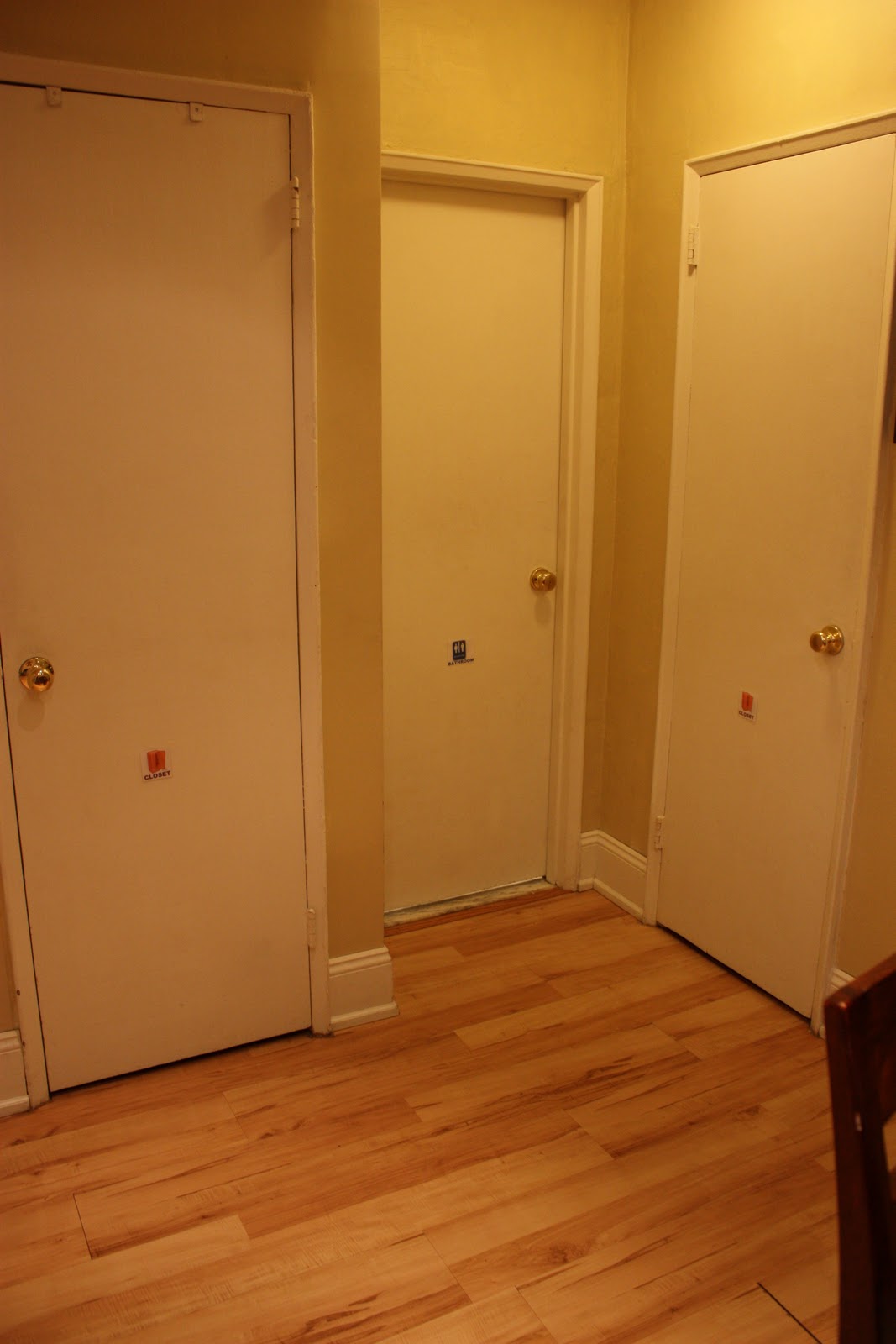
I went on a preschool visit and saw that they had labeled everything with words.  Great idea!, I thought  I can totally do that.   (While I don't expect her to start reading any time soon, it can't hurt to create a text rich environment.)   And so I made labels:
written on sentence strips, laminated, and then hung up with painter's tape

Then I later realized that if we're teaching Maya with PECS (picture cards, or pictures on the iPad), the labels should really include a picture icon in addition to the words.  Oops.  So I have to redo them.

Then I find out that kids learn capital letters first.  So they have to be fixed again.  Now they have to be all caps and include a picture.  Also, everyone who texts/emails/blogs/etc knows that CAPITALS are for YELLING.  So I was less than enthused that my "chair"s  and "door"s were about to become "CHAIR"s and "DOOR"s.  I envisioned walking into my kitchen in the morning and being visually assaulted from the moment I flipped the LIGHT SWITCH and walked past the CABINET, DRAWER, and GARBAGE to the REFRIGERATOR. 

Not cute.

(As it turns out, with a decent font and good clip art, the text is less AGGRESSIVE than I thought it might be.  Thank goodness.)

Here's the step-by-step process (so you can do it yourself without having to reinvent the wheel) of the new-label-making. 

Step 1: This is what I came up with, through googling clip art images and formatting in a word document:***


 Also, I can't spell REFRIGERATOR, in case you didn't notice.  I fixed it and reprinted, but I'm too lazy to take new pictures, and I also don't care if you think that I can't spell.

Step 2: I cut out all of the labels, because they laminate better individually:


Step 3: Set them up in sheets to be laminated:
Pre-lamination

 Post-lamination

 Post-lamination, again

Step 4: Cut out the laminated squares.  *Remember to round the corners, because kids will rip these things down ad nauseum  and you don't want scary, sharp edges.


Step 5: Hang them up (painter's tape works well) around eye level.  I taped these up near the bottom and then remembered she's not a crawler anymore, and I had to move them up!

 These say closet, bathroom, closet.  I mean, CLOSET, BATHROOM, CLOSET

One labeled drawer and cabinet.  Her speech therapist said there's no need to label every single thing---which would be overwhelming---so just pick a few to label. 

***DO YOU WANT TO MAKE THESE LABELS AT HOME?!?

I've already done the work to find decent images and format this stuff.  There is no need for you to start from scratch---shoot me an email (uncommonfeedback@gmail.com) and I would be happy to send you the word document.  You may need to tweak them (you probably don't need "PARKER'S CRATE") but at least you won't have to reinvent the wheel.  It makes me crazy that we all are constantly trying to come up with new things, and we probably could just get some great easy ideas from each other.

Tuesday, November 30, 2010

Here we come, walking down the street*

Maya's figured out that Parker gets walked on a leash, and now she wants to be the one holding it.  So I devised a 2 leash system that lets her "walk" him from the stroller, but lets me be in charge (just a little sprinkle of uncommon sense) . . . poor Parker is slightly confused about where to walk, but he's figuring it out. 

Here's what it looks like:


I feel a little bit like I'm operating a sled dog team with the stroller in one hand and the leash sticking wayyyyy out in front of me with Parker walking near the front of the stroller . . . I can't imagine what people are thinking as we walk towards them on the sidewalk.  But if Maya can't see where Parker is, she keeps twisting around in the stroller . . . and I'm trying to introduce the phrase "With Maya" to tell Parker when to heel to her.

*If you watch the video closely, you'll also get a glimpse of my fun new puffy magenta coat, and one of the new Starbucks cups in action.)

**Tomorrow December arrives, the most fun month of all.  Stay tuned for a walk down Holiday Card memory lane, starting with Maya's first holiday card (2008).
***If you see an empty space with a play button, just click it and the video will appear.

****If you took the time to read all of these stars, you get 7 points. 

Tuesday, October 5, 2010

Amsterdam International

To fully get this post, please read (or re-read) Welcome to Holland before starting.  Thanks.

In the special needs world, there is a poem (essay? whatever.) called "Welcome to Holland."  It is supposed to explain what it's like to have a child with special needs.  It's short and sweet. 

It skips everything.

While "Welcome to Holland" has a place, I used to hate it.  It skipped over all of the agony of having a child with special needs and went right to the happy ending. 

The raw, painful, confusing entry into Holland was just glossed over.  And considering the fact that this little poem is so often passed along to new-moms-of-kids-with-special-needs, it seems unfair to just hand them a little story about getting new guidebooks and windmills and tulips.

If I had written "Welcome to Holland", I would have included the terrible entry time.  And it would sound like this:


Amsterdam International

Parents of “normal” kids who are friends with parents of kids with special needs often say things like “Wow! How do you do it? I wouldn’t be able to handle everything---you guys are amazing!” (Well, thank you very much.) But there’s no special manual, no magical positive attitude serum, no guide to embodying strength and serenity . . . people just do what they have to do. You rise to the occasion, and embrace your sense of humor (or grow a new one). You come to love your life, and it’s hard to imagine it a different way (although when you try, it may sting a little). But things weren’t always like this . . . at first, you ricocheted around the stages of grief, and it was hard to see the sun through the clouds. And forget the damn tulips or windmills. In the beginning you’re stuck in Amsterdam International Airport. And no one ever talks about how much it sucks.

You briskly walk off of the plane into the airport thinking “There-must-be-a-way-to-fix-this-please-please-don’t-make-me-have-to-stay-here-THIS-ISN’T-WHAT-I-WANTED-please-just-take-it-back”. The airport is covered with signs in Dutch that don’t help, and several well-meaning airport professionals try to calm you into realizing that you are here (oh, and since they’re shutting down the airport today, you can never leave. Never never. This is your new reality.). Their tone and smiles are reassuring, and for a moment you feel a little bit more calm . . . but the pit in your stomach doesn’t leave and a new wave of panic isn’t far off.

(Although you don’t know it yet, this will become a pattern. You will often come to a place of almost acceptance, only to quickly re-become devastated or infuriated about this goddamned unfair deviation to Holland. At first this will happen several times a day, but it will taper to several times a week, and then only occasionally.)

A flash of realization---your family and friends are waiting. Some in Italy, some back home . . . all wanting to hear about your arrival in Rome. Now what is there to say? And how do you say it? You settle on leaving an outgoing voicemail that says “We’ve arrived, the flight was fine, more news to come” because really, what else can you say? You’re not even sure what to tell yourself about Holland, let alone your loved ones.

(Although you don’t know it yet, this will become a pattern. How can you talk to people about Holland? If they sweetly offer reassurances, it’s hard to find comfort in them . . . they’ve never been to Holland, after all.


And their attempts at sympathy? While genuine, you don’t need their pity . . . their pity says “Wow, things must really suck for you” . . . and when you’re just trying to hold yourself together, that doesn’t help. When you hear someone else say that things are bad, it’s hard to maintain your denial, to keep up your everything-is-just-fine-thank-you-very-much outer shell. Pity hits too close to home, and you can’t admit to yourself how terrible it feels to be stuck in Holland, because then you will undoubtedly collapse into a pile of raw, wailing agony. So you have to deflect and hold yourself together . . . deflect and hold yourself together.)

You sneak sideways glances at your travel companion, who also was ready for Italy. You have no idea how (s)he’s handling this massive change in plans, and can’t bring yourself to ask. You think “Please, please don’t leave me here. Stay with me. We can find the right things to say to each other, I think. Maybe we can have a good life here.” But the terror of a mutual breakdown, of admitting that you’re deep in a pit of raw misery, of saying it out loud and thereby making it reality, is too strong. So you say nothing.

(Although you don’t know it yet, this may become a pattern. It will get easier with practice, but it will always be difficult to talk with your partner about your residency in Holland. Your emotions won’t often line up---you’ll be accepting things and trying to build a home just as he starts clamoring for appointments with more diplomats who may be able to “fix” it all. And then you’ll switch, you moving into anger and him into acceptance. You will be afraid of sharing your depression, because it might be contagious---how can you share all of the things you hate about Holland without worrying that you’re just showing your partner all of the reasons that he should sink into depression, too?)

And what you keep thinking but can’t bring yourself to say aloud is that you would give anything to go back in time a few months. You wish you never bought the tickets. It seems that no traveler is ever supposed to say “I wish I never even got on the plane. I just want to be back at home.” But it’s true, and it makes you feel terrible about yourself, which is just fantastic . . . a giant dose of guilt is just what a terrified lonely lost tourist needs.

Although you don’t know it yet, this is the part that will fade. After you’re ready, and get out of the airport, you will get to know Holland and you won’t regret the fact that you have traveled. Oh, you will long for Italy from time to time, and want to rage against the unfairness from time to time, but you will get past the little voice that once said “Take this back from me. I don’t want this trip at all.”

Each traveler has to find their own way out of the airport. Some people navigate through the corridors in a pretty direct path (the corridors can lead right in a row: Denial to Anger to Bargaining to Depression to Acceptance). More commonly, you shuffle and wind around . . . leaving the Depression hallway to find yourself somehow back in Anger again. You may be here for months.

But you will leave the airport. You will.

And as you learn more about Holland, and see how much it has to offer, you will grow to love it.

And it will change who you are, for the better.

© Dana Nieder 10/2010 All Rights Reserved