Showing posts with label PECS. Show all posts

Thursday, October 27, 2011

I will not be her limiting factor

At the risk of becoming a one trick pony, I'm going to hesitantly start another post on communication.

Exactly a month ago, I posted about finally making the leap and learning how to use BoardMaker.  The timing wasn't accidental.  Maya had been toying with the iPad for the past 8 months or so during her therapies.   I had made a few picture cards here and there, but without much direction.  As the summer rolled on I told myself "When school starts, we will get a system in place".  It didn't seem to make much sense to create a system on my own when preschool (filled with lots of people-who-know-how-to-communicate-with-nonverbal-little-kids) was right around the corner.

School started.  I waited for her to find her footing.  I spent a few hours learning BoardMaker.  I met with Maya's teacher and speech therapist and saw the types of boards they were using at school.  I made some boards at home.

I puzzled over the fact that having a finite number of words available meant that I was chosing everything that Maya was able to say.  I hated that.  It didn't seem fair.

I made keep making the Word Book.  With it, Maya will flip through the pages, pulling off words and handing them to me, eyes lighting up with delight when I say "alligator?" or whatever word she's thinking.  She understands that the book lets her get her thoughts out.  She plays with the PECs (picture cards).  She's starting to learn how to point her way through "I want" sentences.  It's exciting-beyond-words that she's able to tell us stuff.

But it's killing me.

Something about seeing her latch onto this book so quickly (and I really mean "latch on"--literally and figuratively---she's taking the thing in her crib at night . . . don't take my words away, mommy, I might need them tonight) is simulatenously delighting me and breaking my heart.  She's so young and teachable and interested, and I've realized that the limiting factor is her communication isn't her . . . it's me.

Sure . . . it's her mouth's fault that she can't speak words, but it's my fault that she can't communicate.

She doesn't sign much . . . because I haven't followed through with continuing to teach ASL, since her signs are garbled and while I understand them, others won't.  So I just kind of gave up on signing, I guess.  It wasn't a conscious decision, it just  . . . happened.  She started making sounds and gesturing and taking my hand to lead me to things and most of the time, I understood her.  So it was easy not to use PECs regularly, or any real system----she understood me and I understood her and it led to kind of a lazy complacency. 

Now she's starting to use the PECs, and starting to use the iPad more (it's taking me time to upload pictures and format the program, but we're using it in baby steps) and she's learning.  She's interested.  The learning is slow, but it will come.

I give her something new, and she tries to learn it. 
 
  
I'm the limiting factor. 


If I don't make-it-for-her/give-it-to-her/customize-it/set-it-up then her communication is limited.  And it's limited because of me.


This line of thinking . . . well, it's not so good.  I've been throw into a kind of emotional spiral over this . . . whatever I'm doing, I don't feel like it's enough.  But it's certainly enough to keep me in front of the computer day and night, googling and searching and emailing.  It's enough to cut into my sleep.  It's enough to obsess over.  It's an unhealthy place to be.

And then I realized that I can turn some of this negative energy from self-loathing into just plain old loathing (and not that any loathing is ideal . . . but of those two, I'd take the latter).  I am angry at "the system" again. 

I want Maya to get a communication device.  A real one, a big one, one that she can gently be exposed to now and grow into and use for years to come.  I want it soon. 

I want it because Maya deserves it.

But, somehow, it's not my choice.  I can refer her for evaluations (done).  The evaluators will recommend the product that they think is best for her (which I've found to be a gross misrepresentation of her ability).  I can protest . . . but, well, you know . . . I'm "just a parent".  I'm not the professional.  How could I possibly know more about this stuff than the professional?  The device that she receives from the Board of Ed will most likely just be the one that the professional recommends, and then we wait while a year goes by.  A year!  In a year I think she could make some very nice slow and steady progress with a device.

I am educating myself.  I am emailing people-who-know-things about augmentative communication*.  I am leaving messages with representatives from the big companies*. 

I am thinking that we will likely try to pursue getting a device privately, because why-should-Maya-have-to-wait-for-the-Board-of-Ed-to-believe-that-she's-ready?   I believe that's she ready.  Or at least approaching ready at a speed of faster-than-a-year-from-now.


I will not be her limiting factor.


And I won't let the professionals** be her limiting factor, either.


And, just because I can't resist sharing the cutenes:

Roar!!!!  This little dragon can't wait for Halloween.

*To this end, if you know anyone who knows about augcomm, has a child with a device, works in assitive technology, etc, please email me: uncommonfeedback@gmail.com 

**Just to be clear, "the professionals" are not the people at Maya's preschool.  We love the people at Maya's preschool.  "The professionals" are the city evaluator people/BOE.

Monday, October 24, 2011

My kid is nonverbal, we use an iPad, and I still didn't like that piece on 60 Minutes

Last night there was a piece on 60 Minutes that has everyone in the special needs community talking (or at least tweeting and posting on Facebook).  The segment, which can be viewed on their website, was about nonverbal kids who can use iPads to communicate.


Wait, no it wasn’t.


It was about kids with special needs, primarily nonverbal, who can use the iPads to communicate and for other educational purposes.


No, no.  That’s not quite right either.


Ok, for real this time.  It was called “Apps for Autism”.  And, frankly, that pitch had me annoyed before Lesley Stahl even began her introduction. 


Don’t get me wrong—I’ve got nothing but love for children with autism, and their families.  I’m sure that many of you reading this right now are a part of the autism community.  However, I think that “autism” also has a magical buzzword factor that “special needs” is lacking.  I would have greatly preferred a piece about “Apps for Special Needs” or how about just “Apps for Communication”?  “Apps for Special Education”?  “Apps for Communication, Motivation, Special Education, and then a Celebration”?  I mean, I’m just spitballing here, but if I could come up with those gems in less than a minute, I bet the good folks at CBS could have pitched a more inclusive, although possibly less buzzworthy, story.  It would have been appreciated by the throngs of parents, like myself, who have similarly adorable, nonverbal kids that don’t fall on the spectrum.


So, that  was annoyance #1.    Number 1?  Oh yes, there are more.


The first segment showed a young man named Josh (27 years old) using the app Proloquo2Go (P2G) on an iPad to answer Lesley Stahl’s interview questions.  (This is the app that we have for Maya, by the way, although she’s a bit too young to fully use it—it was pretty cool to see an adult move through it so quickly.)  P2G provided Josh with a voice—he could order food at a restaurant, he could answer interview questions, he could talk to his family.


What a fantastic gift.  Seriously.


But the annoyance #2 actually came right before the scene in which Josh was using the iPad.  The camera focused on Josh’s hand, pointing at letters on a laminated sheet of paper, and the voice over implied in the pre-iPad days, Josh’s only way to have a conversation was to spell out his thoughts, one letter at a time.  Lesley then says “For the past year Josh has been using an Apple iPad as his voice.”


Are we to believe that for 26 years, Josh has used only a (poorly) laminated paper keyboard, and then one day he got an iPad and it changed everything?


I damn well hope not.


If so, I am irate on his behalf.  I really, really hope that he was able to use PECs, or a ProgressiveCommunicator or a TextSpeak generator ---- clearly, he can spell, and these devices are all cheaper than the iPad.  Please, tell me he had something.  Even just a typewriter.


On the flip side, if he did have a device before the iPad (and I do believe he did---did you notice that the laminated paper was in QWERTY format?  This kind of implies keyboard use), then I ask----What’s the deal, 60 Minutes?  This seems like mighty questionable reporting.  I get it---you’re selling the iPad as "The Solution" (this segment directly followed a large piece on Steve Jobs, by the way).  But it seems like you’re heavily lying by omission, to say Josh had to fingerspell or act out his thoughts . . . until THE IPAD came to the rescue . . . when really, many of us who have nonverbal kids are raising an eyebrow and thinking “Really?  How can that be?”


Maya has an iPad, and I love it.  I look at it and I see potential—new apps roll out, and we can buy them and try them and see what works.  However, when she’s fully ready to use an AAC device, I want her to have a true communication device (like this one, from  Dynavox). Why?  Well, those devices are created by speech and linguistics people, fully mapped out and set up for grammar and communication (and really, I’m just repeating what my AT consultant told me.  I don’t know much about that stuff yet, because the time has not come for us). 


Mark my words, I am not an iPad hater.  I think the iPad has a place in education and in communication.  I think that nonverbal children should have early access to an array of items (from PECs to the devices that I mentioned above to iPads) so that their caregivers can find the best way to give each child a voice.  I am very, very grateful for our iPad.  But the way this piece touted the iPad as the tool for communication, counting, motivation, etc, was a little off-putting.  It seemed less like journalism, and more like a commercial.  


At the same time, I’m glad it ran.  I hope that the segment was able to show a large audience that nonverbal people are much, much smarter than meets the eye.  I watched that little boy show off his huge receptive vocabulary and love of opera and I couldn’t help but tear up and think of Maya.  It’s easy for us to know how smart our kids* are, and I like that technology will make it easier for them to show off their skills as they encounter new people. 


*our kids = kids who struggle to express themselves in conversation, regardless of diagnosis

Friday, October 14, 2011

How we talk with our (mostly) nonverbal girl

This is an unedited, not-at-all-set-up photo of what my coffee table looked like this morning. 


That's why there hasn't been a post in a few days . . . I'm nearly totally consumed with Project Communication.  (And the little part of me that wasn't consumed with communicating was actually doing a bit of consulting work, so no free time at all.)  So, it's fitting that I'm here writing another communication-centric post.

Last week I was talking on the phone to a friend, retelling events from the day.  I mentioned Maya's Word Book, and said something like " . . .and then all day she kept saying "library! library!"  My friend replied "Oh my gosh, that's so amazing!!!", which left me puzzled.  It was, after all, more amusing than amazing. Then I realized that she thought Maya was literally saying "library".  I explained that I meant she was "saying" it with the picture card, and then I thought a lot about how Maya "talks" to us.

If you have a child that talks, you probably take a lot of communication stuff for granted.  For us, communication is something we're always working on.  I'm envious of a mom who can call "What do you want for lunch?" over her shoulder and listens for her child to shout an answer from the other room.  For us, talking is deliberate, requiring proximity and props.  Thankfully, most of the time it's pretty easy to understand Maya--she knows what she wants, what cracks her up, and what she likes, and she'll keep trying to "tell" you until you guess correctly (or she gets frustrated and cries,  which is the the saddest part about a kid who can't talk).

To that end, here are some of the ways that we communicate with our (mostly) nonverbal girl.  (Did you see on Facebook that her vocabulary has doubled?  Now she's got "bye" "done" "mama" and "dada"!)  A lot of it is common sensical, but may illuminate things a little bit for readers with "typical" kids who wonder how parents communicate with nonverbal kids.

Note: Maya's receptive language is, without a doubt, one of her biggest strengths.  Because she's able to understand everything with say, I do not need to sign or present picture cards for her to understand what I'm saying.  Also, she has high communicative intent (she wants to tell us what's on her mind), which is also very helpful as we work together to help her express her thoughts.

1. The most basic, oh-so-simple stuff 
  • First of all, we ask a lot of yes or no questions.  She can nod or shake her head, and make small yes ("eh") and no ("nnn") sounds. 
  • We present her with choices (foods, for example) and she can pick one.
  • We ask her questions and show her how to show us her answer Ex. "Maya, do you want to play in the living room (pointing towards living room) or your bedroom (pointing towards bedroom)?"  Then, she'll point to show us.
  • We still use signing.  The problem with signing is that we understand her signs, but they are kind of garbled . . . which is why we made the MSL (Maya Sign Language) translation video for her teachers.
  • We understand her sounds.   "mmm" means, like, 17 different things, depending on context.  Sometimes we have to guess a few times, but she's (mostly) patient.

2. Low tech stuff
  • Paper & pencil (or wipe board & dry erase marker):  This is great for choices on-the-fly, and works on word recognition as well.  Maya isn't currently reading, but if I tell her the words that I've written down, she will remember and choose.  (It's tricky to explain, see the video below)
  • Hands: Even lower tech the paper & pencil, I use this when I want her to make a choice and I don't have any pictures or paper with me.  Check this out in the video, as well:


  • Picture cards (first made with photos, now with BoardMaker symbols) are really helpful.  When presented with a large field of choices, Maya will work to search for something that she wants, or something that she wants to say, and will give it to us.  We started with just a few cards to make choices with, and now are moving our way up to a full communication book (which explains that picture of my coffee table.  I've been staying up late to make more and more words for her). 
3, High tech stuff
  • iPad & Proloquo2Go:  As mentioned a few months ago, Maya has an iPad and an app called Proloquo2Go.  P2G is great, but the iPad is cumbersome.  To truly use P2G effectively, Maya will need to learn to navigate through folders with the touchscreen, tapping and sliding her finger to do so.  Right now, those motor skills are challenging and distracting enough to discourage its use (although we do have a stylus that sometimes helps with tapping buttons).  This week Maya will start using the iPad at school during mealtimes only (so she won't have to navigate through screens) and use the Word Book the rest of the time.  Hopefully she'll slowly adapt to the iPad and we'll use it more and more.  The biggest benefit is that it literally has a voice---she lights up when she hears it say what she's thinking :)
  • Other devices:  We have submitted paperwork that will give Maya an assistive tech evaluation, so we can see if any other devices would be a good fit for her right now.

So, that about sums it up.  Even though she doesn't talk, she actually communicates very clearly (to us, anyway). 

It's very exciting to see her eagerness to communicate, and I'm anxious to see how far she's come in a few months.  Trying to launch the Word Book and iPad simultaneously is nearly drowning me (especially after 1.5 hrs at the Apple store yesterday, and then a 2.5 hour upgrade/redownload/restore process last night), but it will be good.  Maya will show us what works best, it's just a matter of being patient and determined and teaching her both systems, so that we can follow her lead.

In totally unrelated news, here is the cutest art project ever (she brought it home today):

Those jungle animals are made from her handprints!  This could not be cuter.

Saturday, March 26, 2011

A DIY label project that I can help you with

Lately I've been aggravated.  I've had a few projects going on, and went to an iPad workshop on Thursday, and all week long I keep thinking "Someone must have done this before.  I can't be the only person trying to  put labels around an apartment/use an iPad for communication/do other random teachery things for a nearly-3-yr-old with delays." 

It's so frustrating to think that other people have done some trial-and-error stuff and perfected some great ideas, and I don't know what they are.  Instead, here I am, trying to come up with everything on my own . . .  and I never get anything right the first time, so I have to keep redoing the same stuff. 

Here's an example:

I went on a preschool visit and saw that they had labeled everything with words.  Great idea!, I thought.   I can totally do that.   (While I don't expect her to start reading any time soon, it can't hurt to create a text rich environment.)   And so I made labels:
written on sentence strips, laminated, and then hung up with painter's tape

Then I later realized that if we're teaching Maya with PECS (picture cards, or pictures on the iPad), the labels should really include a picture icon in addition to the words.  Oops.  So I have to redo them.

Then I find out that kids learn capital letters first.  So they have to be fixed again.  Now they have to be all caps and include a picture.  Also, everyone who texts/emails/blogs/etc knows that CAPITALS are for YELLING.  So I was less than enthused that my "chair"s  and "door"s were about to become "CHAIR"s and "DOOR"s.  I envisioned walking into my kitchen in the morning and being visually assaulted from the moment I flipped the LIGHT SWITCH and walked past the CABINET, DRAWER, and GARBAGE to the REFRIGERATOR. 

Not cute.

(As it turns out, with a decent font and good clip art, the text is less AGGRESSIVE than I thought it might be.  Thank goodness.)

Here's the step-by-step process (so you can do it yourself without having to reinvent the wheel) of the new-label-making. 

Step 1: This is what I came up with, through googling clip art images and formatting in a word document:***


 Also, I can't spell REFRIGERATOR, in case you didn't notice.  I fixed it and reprinted, but I'm too lazy to take new pictures, and I also don't care if you think that I can't spell.

Step 2: I cut out all of the labels, because they laminate better individually:


Step 3: Set them up in sheets to be laminated:
Pre-lamination

 Post-lamination

 Post-lamination, again

Step 4: Cut out the laminated squares.  *Remember to round the corners, because kids will rip these things down ad nauseum  and you don't want scary, sharp edges.


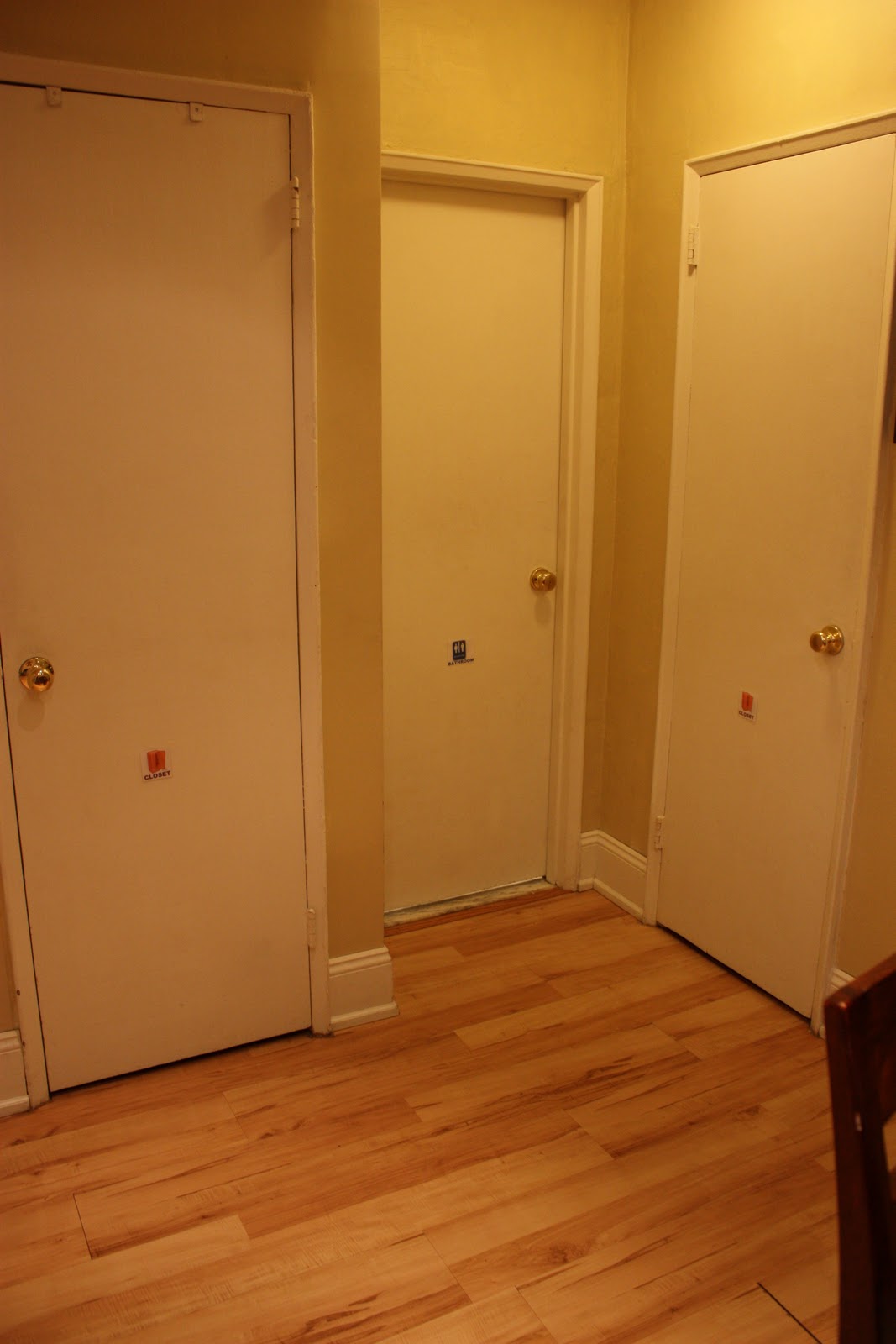
Step 5: Hang them up (painter's tape works well) around eye level.  I taped these up near the bottom and then remembered she's not a crawler anymore, and I had to move them up!

 These say closet, bathroom, closet.  I mean, CLOSET, BATHROOM, CLOSET

One labeled drawer and cabinet.  Her speech therapist said there's no need to label every single thing---which would be overwhelming---so just pick a few to label. 

***DO YOU WANT TO MAKE THESE LABELS AT HOME?!?

I've already done the work to find decent images and format this stuff.  There is no need for you to start from scratch---shoot me an email (uncommonfeedback@gmail.com) and I would be happy to send you the word document.  You may need to tweak them (you probably don't need "PARKER'S CRATE") but at least you won't have to reinvent the wheel.  It makes me crazy that we all are constantly trying to come up with new things, and we probably could just get some great easy ideas from each other.

Sunday, March 20, 2011

Feeding drama and a magic solution (that you can make, too)

For the past month, meals have been really hit or miss with Maya.  Her feeding issues have gotten more complex as she's gotten older, because the behavior challenges of toddlerhood (asserting herself, being dramatic*, etc) are coming into play.  When she first started feeding therapy, everyone agreed 100%--she wants to eat, she loves food and flavors, she just can't do it. 

But now, sometimes she's difficult because her mouth is tired or disorganized, and sometimes she's difficult because she's 2. 

And 2-year-olds are sometimes just difficult.

The basic background on Maya's eating stuff:  Progressing to purees/baby food was challenging.  Once she had a handle on purees, progressing to real stuff (yogurt, applesauce) was challenging, too.  (That started to really happen around 15 mos old).  Then, progressing to real food was a lot of work, because things just get lost in her mouth---her tongue had to learn to move the food to her teeth, her jaw had to learn to make her teeth chew.  (She still has to work a lot on the chewing, because her jaw muscles are weak.  And her mouth is still disorganized.)  We were on all "real" foods around 27 months.   Now, her diet is pretty limited to things that you don't have to chew too much:  milk, yogurt, applesauce, chicken nuggets, grilled cheese, waffles, pancakes, french fries/potatoes, cheese, meatballs/meatloaf, fish sticks, spinach pancakes, soft fruits, and vegetables that are steamed and mashable, etc. 

She is fully capable of eating everything that I just listed, but suddenly she was refusing to eat for me.  She would sign that she was hungry, get in the highchair, and have a meltdown.  She would clamp her lips, throw herself to the side of the highchair, cry, take food out of her mouth after I had put it in, cover her face with her arms, etc.  Misery.  It is not fun to have to fight through every meal and snack everyday.  More than once I would have to hold her arms down, pry her mouth open, and put food in. 

A few times I thought "She must not be hungry", tossed the food, and took her out of the high chair . . . but no sooner did her feet hit the floor than she would smile and sign "Eat!"

(sigh)

I realized that we weren't tapping into her logic skills at all, so I tried to tell her "One bite, and then ________  (stickers, barn, whatever)."  It worked, but only for one bite.  Doing an entire meal one bite at a time takes a longggg time.

And then came the magic solution (care of our speech therapist).  It's so simple (especially if you have any knowledge of preschool stuff, the land-of-labeling-things-with-pictures) and yet so effective:

Ta-da!!!

That's our new meal chart (chart?  I'm not sure if that's the right word.  But you get the idea).  The little pictures of the guy with the spoon say "eat" at the top.   The star is a "surprise".  

How we use it

Me: Maya, do you want to have some stickers?

Maya: (smiles and nods emphatically)

Me: Ok, then you need to take 3 bites of waffle (pointing to the 'eat' cards) 1-2-3, and then you get stickers! (pointing to the star)

Maya: (nods and opens her mouth to take a bite)

As she bites, I take the 'eat' pictures down and say "Great job!  That bite is done, so you have 2 more, 1-2, and then stickers!"

When the bites are done, she plays with the toy.  I keep feeding her, and sometimes she doesn't notice.  If she starts refusing food, I take that toy away, reload the 'eat' pictures, and start again.  If the toy loses its motivational factor, I get a new one.

No more drama. 

No more fighting.

The chart is 2 sided, so she's looking at the side she's working on, we're looking at the back.

In action-here she's taken 1 bite of waffle and has 2 left before she gets the school bus with the zebra and polar bear.  Obviously, school busses carry zebras and polar bears.


Do It Yourself
There are endless variations to this, but here's how ours is made:


-The standing-up part is the bottom cut off of a manilla file folder (which makes it easy to stand up).  There's a sentence strip glued onto it, and 5 velcro dots stuck on in a row. 

-The squares are color printed and laminated, with Velcro dots stuck on the back. (If you don't have a laminator, it's worth getting.  Like I said, I didn't make this, but I do laminate everything.  Maya's been carrying around a laminated picture of her with Santa since December.)  The icons are from Boardmaker, I think, but you can use any picture you want.  Just do a google image search, copy the picture to a word document, and print it up.

And you're done.   So easy.

Oh, and it's perfect to travel with, too.

At the diner, with one bite left until she gets her Santa picture.

The same idea of simple velcro visuals is often used to create schedules for the day (first you make your bed, then you take off pajamas, then you put on clothes, etc, etc), but I can see it working for other obnoxious challenging behaviors, too. 

For example, is tooth brushing a problem?  (It sometimes is for us)  Maybe one parent could brush while the other parent methodically removes numbers from a countdown, or a row of toothbrush pictures to show that time is almost up.  The possibilities are endless.

I'm sure this is a been-there-done-that post for a lot of folks with older kids, but I hope it helps someone else out there.  I think it's a great model to present ideas/routines to all kids---special needs or no special needs.


*Speaking of drama, did you see my story on FB from earlier this week about having a cry alone in the crib?  Yikes.

Wednesday, October 13, 2010

Busy-ness, Crafty-ness, ____________ (I really wanted a 3rd -ness, but I've got nothing)

It's turning out to be another hectic week over here.  A few extra appointments/meetings, and the week is basically packed to overflowing.  Maya helped out by figuring out how to climb into her stroller:

 Yes, that's very helpful.

We're still in the beginning phases of teaching Maya how to use PECS (it's a picture card system that she can use to communicate).  I love the idea of it . . . although I can understand her signs, and Dave understands most of them, they still get garbled up.  So the cards would let her communicate with anyone!  I printed some up and laminated them, but they were too thin and difficult for her to pick up.   After 2 days of struggling I can up with this:


I glued them onto our old foam alphabet mats (you know, the kind everyone has) and then cut them with kitchen scissors (they were really easy to cut).  So now they're easy enough to pick up, and light, and easy to clean!  (When I mentioned this last night to some other moms of kids with special needs, one said "You're like the Martha Stewart of special needs!"  That's still making me laugh today :) )

Amsterdam International is continuing to make the rounds.  It's now up on 11 sites/blogs that I know of, with at least one more to come on Saturday morning.  I'm going to make a link list on the side at some point (maybe tonight?  don't hold your breath, but it's possible).  And 258 people have shared the link on Facebook----have you?  Why not just throw it up there for a little bit?  You never know who might be touched by it . . .

I realized that I posted a cute album of photos on the blog's Facebook page from my niece's birthday, but didn't add any here.  So I leave you with our most recent family pic (well, minus Parker):