Showing posts with label DIY. Show all posts

Tuesday, September 4, 2012

AAC homeschooling: Princesses teach -ing verbs

First, let me say that the title is both accurate and tongue-in-cheek.  Maya learns most (as in over 99%) of her AAC use with me at home . . . but that's where our "homeschooling" ends, as she is in full time preschool.  Second, let me preface this by saying I am not an SLP or AAC therapist, so I'm likely making some mistakes here.  (I do consult via email, Twitter, and phone with AAC folks and read everything I can get my hands on, so the stuff that I try out isn't random, but it's not perfect, either.)  If you are an SLP/ATP please feel free to comment with tips & tricks.


Since ISAAC, I've been thinking a lot about Maya and the talker. I would like her to become more independent with it, able to form different types of sentences (besides the "I want xyz please " that she has mastered), to comment on life, to ask questions, etc.  Perhaps the most important thing to do with a kid who uses AAC is to model, model, model speaking with their device (like I say "I like waffles" and tap it on the talker at the same time) . . . but I've been realizing that this isn't enough.  If I want to have a shot at closing the gap between Maya's receptive language (what she understands---seemingly everything) and her expressive language (what she can say, via words or device or whatever), I'm going to need to really target some skills and teach them, through little activities and lessons.

So I've spent about a week reading about typical language development, and then about language development in AAC users.  Then I read about core words and sight words and the most commonly used words in conversation by preschoolers and school aged children.  I had a list of possible things to target (which was way too long) and a list of questions (which was way, way too long).  Some slight harassing of therapists via email and Twitter, combined with a long phone call from one of my favorite AAC specialists, and I felt like I had narrowed things down.

Where to start?  For today, I went with -ing verbs. 

Maya has only had infinitive verbs open on her talker so far (eat, make, help, listen).  I learned that the next verb form that kids typically incorporate in their speech is the -ing (eating, making, helping, listening).  I thought of ways that we could easily use this in conversation and apply it to life (some listed at the bottom of the post), so it seemed to make sense to target. 

And I knew just who could help me---the princesses.  Because Maya *loves* the princesses.

So last night I made flashcards with the princesses doing different things.  (Thanks, Google images.)  I wrote the verbs on the back, but if I were going to re-do this I would probably write them smaller or leave them off, because I've also been thinking about how these cards could be used for a lot of different things.  (Shout-out to my awesome husband for teaching me how to print pictures on index cards, saving me cutting & gluing time.)


Today Maya & I sat together to make a princess book using these cards.  Here's what we did:
 
1. We selected a princess card, looked at it together, and talked about what the princess is doing on each page.  (The next time that we do this I will likely model "What is she doing" for each page, but I didn't want to overwhelm her this time around)
 
2. I would write the sentence "Princess is xxx-ing" and model it with the talker. 
 
3. Maya would "read" the sentence with the talker.  This required various degrees of prompting, which I expected because these words were new to her.  The hope is that over time I can fade the degree of support that she needs.
 
4. We tape down the card and move on.
 
She had a great time and was really excited about the cards :)  The book making was fun and easy, and since the book will likely be destroyed by bedtime we can start over anew next time!  Here are some pictures:
 
At the end, checking out her book and extra cards

I wanted to take a picture of the book but she wouldn't hand it over.

This was the best I could do.
 
Here's a video.  A few things: ignore the chaos in the apartment, as I've mentioned we're painting and re-arranging and stuff is everywhere. Also, sorry for the weird angles---it's difficult to figure out how to tape an activity when I need to be in it as well.  This video gives you the start of the activity, the making of two pages (from across the table and also showing Maya on the device) and the ending as well.  It's on the longer side (but still less than 5:00), but I thought that seeing more is better than seeing less if you're trying to replicate things at home. 


 If you can't see the video above, here's a direct link: http://youtu.be/TCUUzbLi26w
 
Ways that we can incoporate & reinforce -ing verbs:
  • ask Maya what she is doing so that she can answer "I am xxx-ing"
  • model by describing what we are doing "I am cooking" "Daddy is writing" "Parker is sleeping"
  • describe what other people/animals are doing on tv shows (if you have DVR and can pause it, that would work really well) "Elmo is dancing"
  • describe what other people/animals are doing in books "Maisy is walking"
I'm also hoping to make the leap to pronouns in the near future, and I'm thinking about how he & she will be helpful for this.  I could make cards with some boys on them (princes? pictures of daddy/grandpas/her cousins) and shuffle them into the princesses and then she could pick between "he" and "she."  But we're not there yet.

Would these princess cards be helpful to you?  If you send me an email (uncommonfeedback@gmail.com)  I'd be happy to email back the word document with these images, which is formatted to print onto 3x5 index cards.


Saturday, August 11, 2012

Beach Trip (and AAC on the road)

After flying in from ISAAC late last Thursday night I had two days to unpack, regroup, and repack before we headed out for a few days at the beach with my family.  We all had a delightful time (although I sadly had to skip boogie boarding this year, for obvious reasons). Maya not only loved being with her extended family, but she loved the ocean and the beach (last year she liked the beach, but not so much the ocean).  Great times were had by all.

But there was a little problem . . . one that other high-tech AAC users might anticipate, but many others might not see coming.  If you've ever been to a beach, you know that sand has a way of getting into everything, and never leaving.  Ever.  Because of this, there was no way we were going to bring the talker to the beach, with or without its fancy case (to be clear, we took it to the hotel, but not out on the actual beach).  And so I scrambled to come up with some sort of low-tech AAC system that would allow her to speak while playing in the sand and water.

What I came up with might not be perfect pedagogically speaking, but it was perfect for Maya.  And as I learn more about how to ideally incorporate AAC into daily life, I'm also learning that "ideal" is a hard place to aim if you're kind of Type A (which I sometimes am) and that maybe the most important thing is just to try everyday, to be mindful, to model, and to keep at it.

Let me show you what I came up with, explain how I did it (it's easy, you can do it too) and then point out how it can be modified to be a bit more ideal.

To put it simply, I made 3 boards, connected with a binder ring.  Here's Maya with the boards in action at the beach: 


 "I need more water in my bucket"

 "I'm in a hole" (dug with love by her daddy)


The first board consisted mainly of core vocabulary (only the core words that I thought would be most essential while playing in the sand), laid out in roughly the same orientation that she's used to on the main page of her communication app.  I also added in pictures for the family members who were on the trip with us. 


The second page was really the one that she used the most.  On this board I included fringe words that I thought she would need to talk at the beach.  I intentionally included blank spots for words that I didn't anticipate needing, and brought a few permanent markers along with me so that I could add things in on-the-go.  The words with the green backgrounds are verbs, which are colored according to the Fitzgerald key, if you're interested in that sort of thing (and they are literally colored, with a crayon, because I forgot to print them with green backgrounds and was too tired to do it again).


The organization of these words was done in a way that made sense to me---places went in a column down the left, the top row was beach-set-up stuff, verbs grouped together, etc.  This is not according to any system, I just thought it seemed organized and semi-intuitive.

(The third board, unpictured, contained tiles for all of the colors and a handful of other adjectives: hot, cold, wet, dry, clean, dirty, etc.)

If you're into the DIY details: The picture tiles were created and printed through the Custom Boards app by Smarty Ears.  The symbol language is Smarty Symbols, which is the icon language used by her communication app, Speak for Yourself (clearly, these are pretty basic boards and could be executed with any symbol language that you might be currently using). I cut the tiles out, organized them on blank sheets of computer paper, and taped them down with scotch tape.  Then I broke out the trusty lamintor, laminated & hole-punched.  (Seriously, everyone needs a laminator, especially if you're DIY-ing AAC stuff at home.)  A tip: if you're going to get homemade boards wet, hole punch the sheets of paper, then laminate, then re-hole punch, then run through the laminator again to seal the edges that you just punched.  I didn't think about this and we ended up with a little water leakage near the punch.

This system served us well, especially given the fact that we were on a 4-day vacation and I just wanted something simple that would give her words she needed without creating a system that was so complicated that she wouldn't want to engage with it on the beach (and we would all get frustrated).  Truth be told, it would have been easy to not use the boards at all--to just guess what she wanted (which isn't that hard on the beach) . . . but we're trying to encourage the most fundamental truth of using AAC---something should be there to give Maya the ability to independently say what's on her mind, instead of us guessing while she either says yes or no. 

A few other ideas: A twitter friend (and actual AAC expert) mentioned to me after returning home the possibility of laminating boards/cards/strips of words and attaching them to Styrofoam for accessibility in the water---how brilliant is that?  Then I started to think about how you could attach words to tons of things----for example, the bucket could have words taped to the side with packing tape (bucket, full, empty, fill, dump, pour, sand, water, in, out).  There are a lot of possibilities if you figure out a way to make word tiles and have clear packing tape and a laminator.

It seems to be a good idea to have some sort of low-tech back-up system in place, for beach trips or pool trips or for other messy things that aren't jumping to mind right now.  If I wanted to improve this system of pages-on-a-binder-ring, and make it more advanced, it would likely involve printing some screen shots of the pages on her app for consistency's sake.  There are some issues, though, with how much flipping it would take to build thoughts/phrases/sentences.  I'm not really sure what the ideal solution would look like at this moment (and I say "at this moment" because a low-tech solution that would be ideal for 4 year old Maya would likely be different than what would become ideal for 5 year old Maya).

For now, this was good enough.

A few other beach pictures:

Boogie boarder in training

Maya & Dave

Feeding the seagulls

All 3.8 of us


Disclaimer: As always, I am not an SLP or an AAC specialist, I'm just the mom of an AAC user and I'm primarily figuring out and teaching her how to use her system on my own.  I'm sharing what I've figured out in an effort to help the other parents who are driving their own AAC buses, but take what I do with a grain of salt----I try to use all of the best practices that I've learned/seen, but I'm probably making mistakes as I go. Also, I am not affiliated with (nor do I make any money from) the apps mentioned in this post.


Friday, May 4, 2012

If you're looking for communication solutions . . .

 . . . well, now is a good time to be looking.  There are a few things happening right now that I would be really enthused about (if we didn't already own the apps that I'm about to discuss).  Here's some stuff that you might be interested in:

1. Speak for Yourself Lite*:  Speak for Yourself is the communication app that we use with Maya, which we love (and mention frequently).  Yesterday the Speak for Yourself team released a lite version of the app---which is free!  It's a great opportunity to try the app out and see if it could work for your child (or adults with communication challenges, too).  This is the link to the iTunes page for the lite version, and this is a video overview of the features of the lite version (and the rationale behind them).

2. Speak for Yourself sale*:  If you like the lite version, May is a good month to buy the full version of Speak for Yourself.  Until 5/31 it's on sale for $189.99 (instead of $299.99).

3. Smarty Ears Custom Boards sale*:  Remember the calendar center and schedule that I posted last week?  Those word cards were created by printing Smarty Symbols via their Custom Boards app.  This app allows you to create boards, signs, etc with the Smarty Symbols (the same symbol language used in Speak for Yourself).  It's handy to have if you're using the Speak for Yourself app, because you can create labels, etc that support the immersion in that symbol language.  It's currently half-price ($19.99 instead of $39.99), but only until 5/9


In other news, I've mustered all of my spare determination and waded into the world of Pinterest.  A lot of our stuff has already been pinned by other lovely folks, but I thought it would make sense to create a pinboard that has all of our DIY ideas in one spot.  You can see that here.  I'll be creating other boards, too, the first will likely be of DIY projects that I want to try.  (If you see something that you think I might be interested in, please send it my way via our facebook page or email-thanks!)


*Disclaimer: I don't work for Speak for Yourself or Smarty Ears.  I just like their stuff, and we use it because it's good.

Monday, April 30, 2012

DIY: Creating a Visual Schedule (incorporating AAC symbols)

Project: Create a Visual Schedule (that includes Maya's AAC symbol language) is completed!  Finally.  And it looks pretty darn good, if I do say so myself.   Check it out:


Again, I made the visual schedule to support Maya's interests.  She's into knowing what's going to happen next (we've made schedule on wipe-off boards when she's upset about stopping an activity to show her that we have to do a-b-c, and then you can play with the bus again).  However, even if your child isn't super into schedules, I've seen a lot of stuff online (and heard from therapists) that schedules can be beneficial to have on hand and refer to.  (But don't take my word for it, feel free to talk to your own therapy folks and see what they think.)

Here's a step-by-step guide on how to recreate this visual schedule:

Note:  I built this schedule horizontally (instead of vertically) to support pre-reading skills.  We read from left to right, and it's nice to expose little ones to this idea.

1. Setting up the background:  I got the idea to use a frame as a schedule background from a blog reader, and I loved it!  Prior to seeing her frame I was going to just stick velcro on the wall, but the frame makes it look so nice and finished.  I used a 12" x 36" frame.  For the background I picked up a yard of fabric at the craft store (actually, Maya picked it---see the alligators?) and just folded it inside the frame.  Fabric was easy to put in and will be easy to switch out when we move on from alligators.
 

I put two rows of velcro onto the glass.  I left some extra space at the bottom (you'll see why when you scroll down).  Helpful hint: Attach some word cards to the velcro before sticking the velcro on the frame---that way your velcro strips will be placed far enough apart to accomodate the word cards.

2. Making the word cards:  Since Maya doesn't read yet, her word cards include pictures and printed text.  If your child uses (or will use) PECs or an AAC app/device, it's best to use the symbol language of that system as your pictures.  (Maya uses Speak for Yourself, and so we use the Smarty Symbols that are found in that app.)  In Maya's app each word is represented by a sequence of two pictures, and that's why each word card has two pictures.  (You can read a bit more about that here.)


The general steps for making our word cards went like this: print images, cut out images, tape them onto index card, print word at the bottom, laminate the index card, cut it out, attach velcro to the back.  Time consuming, but in a channel-your-inner-middle-schooler, arts-and-crafty sort of way.


Helpful hint: Use small pieces of velcro.  If you use larger pieces, they become challenging to unstick, especially for kids with any muscle weakness.  Also, small pieces ensures that your child won't pull hard enough to rip the velcro strip from the wall, or crack the glass in a frame.

3. What to do about word storage?  When you make a schedule you're going to end up with a lot of words that aren't in use at any given time (at the bottom of this post I'm including a list of all the words that I've made so far).  I puzzled over what to do with these not-in-use words.  Poking around online, I found that many people kept their spare words in a binder with velcro pages (very similar to the Word Book).  I didn't love this idea, because I wasn't sure where I would keep the big binder.  Since our word cards are 3x5 index cards, I also thought about buying index card boxes----but again, where would they be stored?  Dave came up with the magical solution:  binder rings.

I love binder rings---they're easy to open and close, so we can pop the cards off the ring to lay out choices for Maya, but clean up would be easy as well.  So I punched holes in the sides of the word cards and sorted them into a few separate piles. 

This ring holds the cards for places that we go.

Binder rings make storage really easy.  I bought some of those adhesive hooks at the drugstore and hung them next to the schedule.

4. When the cards are done: As we move through the day Maya will be able to pull the completed cards off of the schedule and put them away.  I wasn't sure what to use for a "done" area until Maya's speech therapist suggested using a folder-brilliant!  I cut the bottom off of a folder, cut down a bit to make the pocket more shallow, covered the edges with tape (in a bid to prevent paper cuts), and added two small pieces of velcro to the back:

Again, small piece of velcro on the folder and a large strip on the frame.

When words are done, they go into the pocket.  Ta-da!


And so the schedule project is mostly done.  I say mostly because I'm 100% sure that over the next week or so I'll realize how many words I forgot to make and be slowly churning them out.  Here are the words that we started with:
Go-to daily words: breakfast, lunch, dinner, snack, ready (get ready for school), bus (to school), school, bus (from school), home, bedtime
Places we go: park, playground, library, museum, zoo, dog park, grocery store
Stuff we do at home: toys, paint, color, dollhouse, read, draw, puzzle, play dough, chalk, play kitchen, choice time
Miscellaneous words: therapist's names, learning time, mouth exercises, bath

(Note: There aren't a lot of details in the morning and evening routines because I'm planning on making a little morning checklist and a little night checklist.)


Thursday, April 26, 2012

A semi-homemade preschool calendar station (with some AAC flair)

Maya has become suddenly interested in calendars.  Well, not completely suddenly.  About a month or two ago she started showing an interest in the calendar, touching the boxes, etc, but it seemed to be mainly due to the fact that she likes to count things.  (She taps each box and we say the numbers for her.)  I thought Oh, I should set up a calendar for her but I was newly pregnant, sick and exhausted, so it got pushed to the back burner. 

I remembered the calendar project this week, when she started to navigate within the talker to say the days of the week.  She liked saying the days, so on Monday morning, during breakfast, I told her "Today is Monday" and showed her where the Monday button was.   About ten minutes later I said "Hey Maya, what day is today?" and she turned to the talker and tap-tapped and I heard Monday.  Smart girl :)  I shot this video at breakfast on Tuesday:


I'm all about supporting her interests*, and so this morning the calendar went up. 

*I'm in no way pushing her to memorize anything here, or suggesting that every home should have a calendar area.  But she's into the calendar and I'm doing a push with our AAC stuff right now, so this came together rather intuitively. 

I'm going to give you the basic plan first (which would work for anyone) and then follow up with the communication/AAC stuff.  Here's what I did:

1. I went to Lakeshore Learning and bought a pocket calendar and then a cute monthly calendar bulletin board kit (which they don't sell online, so no link).  If you're feeling super crafty you could make this stuff, but I'm not super crafty.  I'm functionally crafty.

2. I attached velcro strips to the wall to make sentence strips.  This may mess up your wall.  I'm planning on leaving it up for a while, because we can do all sorts of things with velcro, but I'm fully expecting that paint may get ripped off when I take it down.  That doesn't bother me much, but if it bothers you then you might want to try some other method here.

3. I made laminated cards to use on the sentence strips.  One set talks about the day of the week, so that we can say "Today is Monday."  The other set talks about the weather, so that we can say "The weather today is sunny."  Our cards are a bit fancier than usual, because they incorporate Maya's symbol language.

This is where it's going to get a little speech/AAC oriented, so if you're not interested just scroll down to hit the pictures.  But really, if you have a minute, check this out, because it's really interesting.

In the world of communication apps/devices, words are generally represented both in text form and with a picture.  Different systems use different "symbol languages" (pictures to represent the words)--Boardmaker uses PCS symbols, Proloquo2Go uses SymbolStix, Speak for Yourself uses Smarty Symbols, etc.  If you have a child who uses (or is going to potentially use) a symbol language, it can be beneficial to incorporate those symbols into your environment, as kind of an immersion into the language. (That's just a general best practices thing, I'm not making it up.)  And so, when I started planning the calendar, I knew that I wanted to include Maya's symbol language into the words and labels that I put up, for reinforcement purposes.

In Maya's communication app (Speak for Yourself) almost every word is represented by two pictures (a handful are said by just pushing one button instead of two).  For example, the word dinner is said by touching the eat icon on the main screen, and then the dinner icon on the secondary screen.  Each word card that I made (Monday, Tuesday, sunny, weather, etc) would include both symbols, so that it would be a visual representation of how she would use her device to say the word.

This is all kind of abstract in words.  Let me show you.

Here's the card for dinner:

If Maya wanted to say dinner with the talker, she would first touch the button on the left, then the button on the right.  See?  It reads like a sentence. 


I printed the images out (using this app), cut them, and affixed them onto an index card with a piece of tape.  Then I printed the word underneath and ran the cards through my trusty laminator.


Then I re-cut them and put a small square of velcro on the back of each one (these words aren't all for the calendar, clearly, I have a few other projects in the works).

finished cards

I rearranged the alphabet hallway to make room for a calendar area . . .


which looks like this.


I left the pocket calendar almost completely alone, with 2 exceptions.  I added a card at the top that includes the symbol language for the month, and I glued the symbols onto the yellow days of the week cards:


For the sentence strips, I used the cards with printed words and symbols.  One envelope has the extra days of the week and one has the extra weather-related words. 


This sort of thing could be done for any topic, and with any symbol language.  For now, we'll just play with the idea of putting up the day and the weather.  Once she's used to that routine, we'll start doing it with the talker, and I will model saying the sentence on the wall with the device.  Then I'll start helping her to do that. 

It's practice with the device, it's some nice text-rich pre-literacy stuff on the wall, and, most importantly, it's supporting an interest that she expressed to me---I'm not trying to engage her in something that she doesn't care about.

Disclaimer: I'm not a speech therapist or AAC therapist, just a mom who has done a solid bit of reading, researching, and harassing real professionals via email and Twitter to get their guidance when I have questions.  If any speech/AAC folks are reading this and feel like you have something to add on, or that I've made any errors, please feel free to chime in.  Thanks!


Monday, March 12, 2012

Maya is self-directed (and not in a Woody Allen way)

Last week I found myself sitting in the principal's office.  Of Maya's school.  Because she's acting naughty.

(sigh)

Well, not naughty exactly.  Manipulative. Stubborn. Flightly. Indifferent.  (Those are all my words.)  In preschool language, she is what you would call self-directed, which kind of sounds like a nice thing.  She knows what she would like to do, and will go do it.  Issues arise, however, when her plan doesn't line up with her class's plan.  They're supposed to walk down the hall and she doesn't want to?  Well, maybe she'll just have a seat in the hallway.  She's supposed to practice climbing stairs in physical therapy, and that's not her idea of a good time?  Perhaps she'll just go all limp-noodle on the poor therapist.  She has to take sips from a cup before getting her water bottle?  Well, that's fine, she just won't drink at all, then.

I mentioned these issues last week (after speaking with her teacher) but I was kind of startled by the chat with the principal.  I mean, it's the principal, you know? 

I guess I shouldn't be surprised by this, as I have a killer stubborn streak.  I was always very compliant and pleasant at school, though, and while Maya has a handle on pleasant, the compliance isn't following along.

Interestingly, through the conversations with the teacher, therapists, and principal, I realized that Maya is more obedient at home than she is at school.  I have some theories as to why this is: there are less distractions at home, for one.  Secondly, she only deals with two adults at home, and our expectations have been clear for years.  At school there are many adults (regular teacher, music teacher, 4 therapists, 5 one-on-ones that rotate, depending on the day, the administration, etc). Maya is sly-if one person handles her slightly differently than the others, she will keep wiggling and pushing and looking for ways to get around rules.  Add to all of this the fact that she's cutting a molar and her sleep hasn't been great since the big girl bed switch, and we've got a smorsgabord of possible causes for her recent increase in semi-defiant behavior.

But that doesn't make it ok.

So we're taking some steps.  And, in case anyone else out there is in need of some pro-compliance activities (it can't just be us, right?) here's what we've got going on:

1. For the cup drinking (or, really, and targeted skill that your child is fighting):  I dug into the blog archives (they can be handy) and re-discovered this chart.  Maya's teacher modified it for drinking from the cup (the pictures are now drinking instead of eating, and the star is the same).  She has to take a certain number of sips from the cup before she gets the star--in this case, the water bottle.  It's working well.

2. For general lolligagging:  We got the Time Timer.  She doesn't fully understand it yet, but I can see a million uses for it.  For example, when she is refusing to take off her coat I can just set it for three minutes.  If her coat isn't off before it beeps, then I'll do something.  What?  Um . . .  I'm not sure yet.  Maybe put her bag of stickers in time out.  She loves her stickers.

3. For combatting total self-directed-ness: I'm going to be choosing some of our activities each afternoon.  The timer is going to help me out by showing her that there is a limit to my activity choice, but we will do the full time before we move on.   My choices will be functional---OT and/or academic in nature.  We're referring to my time as "Learning Time."

Learning Time started today.  Over the weekend we had a session with an OT that I love (wish we could just have her come by a few times a week, but we don't have the funds).  Luckily, she loves us too, and we did a session in which she primarily trained me on a pre-writing program that I can do at home.  We did 4 minutes today (which she thought would be an appropriate jumping off point, attention-span wise).  When she got distracted (only twice) I paused the timer, and when we were done I felt super accomplished--and Maya was proud, too :)


If you're thinking that you don't have a pre-writing program to try, don't worry.  I emailed the teacher explaining my Learning Time plan and she was all for it.  I asked her to keep an eye out for skills that I would be able to help reinforce at home and she's already sent me one idea.  Between your child's therapists, teacher(s), and Pinterest*, there are a million fun projects to do.

There are probably people who think "Eesh---therapy and academic stuff should be left for the therapists and teachers."  I just don't feel like that's the case for us.  I came away from today really enjoying the (tiny) session we had, working on a goal together, and Maya really liked it, too.  And since we can't afford unlimited therapy, and I feel like I'm smart and capable, I'm glad to jump in and fill some of those gaps.

If you've got any other tips or tricks, feel free to share them in the comments . . .


*FYI, I've heard that Pinterest is full of ideas.  I still haven't figured out Pinterest.
 

Tuesday, March 6, 2012

Necessity is the mother of invention (possible solution for iPad accidental hits)

It's been a few months now since we started using Speak for Yourself on the iPad for communication.  Maya loves it, and will nod vigorously if you ask her if she needs "the talker."  There's only one flaw to the app (and it's not just limited to this app)---accidental button pushes.  Often Maya will be reaching to touch something with her index finger, but her palm and other fingers foil her plan by bumping into the screen and hitting other buttons.  She accidentally says words, moves through screens, and closes apps that she wasn't intending to. 

Here's a visual:

See?  My intention is to touch the green button, but my hand is bumping the screen at 3 other points, accidentally pushing things.

It's been holding her back.  She often seems to not understand how she ends up on a screen and will then just pick her favorite word to say out of the choices in front of her.  When left on her own she ends up saying things that sound like this: milk-princess-animal-Daddy-Daddy-alligator-purple-milk-cereal bar-orange.  She has a great time, but it's not as purposeful as it could be.

I've tried different things to help her with accuracy.*  Sometimes I put a finger under her wrist to hold it off the screen . . . but this doesn't work well because she gets angry that I'm interfering with her communication, and she grabs my hand and pushes it away defiantly.  I've tried holding on to her index finger to help her reach the button she's aiming for and tap it . . . but in a heartbreaking twist she's starting doing her own hand-over-hand---using her right hand to try to steady her left index finger and tap the screen.  Focused and adorable, yet somehow sad that she's trying so, so hard, and knows that she can't trust one hand on its own.

A few nights ago I had an idea, and today I finally tried it out.  It worked.  But I think it could be improved upon.  (Also, it's entirely possible--probably, even--- that other people are doing this.  I'm not claiming to have invented this idea, but I haven't seen it mentioned so I thought I'd share.)

Here's what you need: 
-a pair of gloves that fits your kid
-a pair of scissors.

Step One: Cut the index finger off of the gloves.

Ta-da!

She's not thumbless.  Her thumb is buddied up in the index finger slot.

The gloves won't activate the screen.  Adults in cold climates are all too familiar with this, as you can't use your touchscreen phone with gloves unless you have special gloves.  So the only part of her hand that can now effectiely touch a button is her index finger. 

 The three fingers that are currently on the screen can't hit any buttons.

Using her pointer finger to hit a button.

This is the best picture, because her knuckles and the heel of her hand are actually resting on the iPad, but not activating any buttons!  She's able to take the time to line up her index finger and hit the button that she is intending to. Success!

Pros:
1. It works.  (Only one pro, but it's the biggest one ever.)

Cons:
1. She has to keep it on.  She managed to for a while tonight, but then wanted to take it on and off. 
2. She has to not eat it.  She likes to chew on stuff, and I can see the glove becoming a target.
3. We will need several pairs.  These are going to get dirty and I'll need back-up pairs.
4. The material isn't ideal-it's thick and bulky.

If I could design the ideal glove, here's what it would be like:**
1. Thin, stretchy fabric: something like nylon?  It would be lighter, more smooth, and less fun to chew.
2. Index finger missing or reinforced with conductive thread (which works on touchscreens). (I think fingerless is easier for her at this stage, though.)
3. Toddler and child sizes available

Eventually, you would want to cut the thumb out too, for apps that involves stretching or pinching things (you know, that motion with the thumb and index finger)---but right now Maya needs to have as little activating surface area as possible showing.

It's not a perfect solution, but it's a start.


*The creators of SfY are working on a keyguard that will help to address the issue of accidental button hits, but I'm trying to come up with something in the meantime.

**If you have any ideas on how I can make better gloves at home, let me know.  I don't sew.  This is foreign to me.


Monday, February 13, 2012

Happy Valentine's Day(ish)

Back in the PM days (that's Pre-Maya) I couldn't have cared less about Valentine's Day.  First, I'm not an overly romantic gal.  Second, the whole forced-day-of-love thing didn't make me warm & fuzzy. 

However, now that Maya's around, I celebrate every day possible.  Valentine's Day, St. Patrick's Day, Labor Day, the Ides of March . . . whatever.  Give me an excuse to do something slightly festive and indulge her a bit and I'm on it. 

I was so ready to celebrate with some low-level craftiness*  . . .  Maya, however, embraced her toddlerhood and had no follow-through, so we ended up with "mostly finished low-level crafts."  Eh.

*low-level craftiness means that the projects are fun and kill some time, but aren't Pinterest uploadable. All of my craftiness is low-level.

First project--make valentines for Maya's classmates.

We got off to a strong start: 

 Painting on rolled-out IKEA paper that I had taped to the coffee table.


Right after I took that picture Maya asked to wash her hands, and then the game was over.  Twice she ran back to the paper, put paint on her hands, and then told me again she needed to wash them.  Painting, done.

While she was at school today I cut the painted paper into little hearts.  After school we worked together to glue them onto construction paper squares.  The final step was to add little sparkly hearts, but Maya wandered away and I decided that I wasn't going to sit on the floor gluing hearts by myself, so that was the end of that.

The one on the right is one of 3 valentines that managed to get adorned with shiny hearts.


Next, we baked cookies.  (The low-level craftiness version of "baking" involves boxed cookies from the refrigerated section of the grocery store.) 

She was SO excited to put them on the pan . . .

 . . . and SO excited to watch them cook . . .

 . . . but when it came time to eat them, she just wandered off again.  We're sending them into school tomorrow.  Also, tomorrow is the class's Valentine's Day party and little Miss Maya is going to get all dressed up.  It's going to be adorable :)


Monday, October 10, 2011

Introducing the Word Book! (Or, how to make your own communication book)

Recently, I've had communication on the brain.    The time has come to implement a system of communication that will let Maya "speak" more easily to those around her.  We've tried picture cards, picture boards, and the iPad, but nothing has really stuck.  All of the systems become cumbersome, or are used inconsistently.  Finally, it seems like we're making solid progress . . . Maya has been a virtual chatterbox this weekend, thanks to a communcation book that anyone make at home, with minimal supplies.

Last week I visited Maya's school twice.  Both times, I was focused on communication (and I also got to spy on a PT session, which was fun).  On Wednesday, I visited her teacher and speech therapist, taking photos of the communication boards that they have been using with her at school.  Here's a picture of a board that she uses while playing with dolls at school:


Pretty basic.  She points to things, the teacher will say them and encourage her to make the starting sounds of the words.

The problem that I had been having at home with the boards is that it's really hard to get the right words on the board.  The pressure of selecting the words was enough to make me come undone.  I mean, when I make a board I'm literally chosing every single thing that she can say.  Imagine if you sat down to play a game and were only allowed to use 20 words, which had all been predetermined by someone else.  I hated that my word choices would limit her.  But that changed on Thursday.

Thursday I returned to the school to attend a workshop on increasing communication at home.  The workshop was mostly useless, except for 1 key point.  Velcro.  At one point the presenter held up a little communication board that had velcro squares on it---and I had a memory flashback to seeing a communication book lined with velcro months ago, so that the board itself is dynamic.  This was what I needed---a board that could easily shift and move, with many words at her fingertips.  So I got to work. 

Note: I'm not inventing the idea of velcro and communication books---many commercial ones exist.  But you can make this at home, and it will be cheap and easy. When I googled how to make your own communication book I found nothing useful.  So this is what I did:

Step 1: Start with the basics.  I made my picture cards in BoardMaker (which makes life easier---but you don't need it.  You can do this with photographs or clipart, too) and put velcro on the back of the squares.  For the book, I'm using a 1" binder with velcro strips.  I figured that there are certain basic words that she would almost always need, so those remain on the cover of the binder:


Step 2: Make the word tiles and put them in the binder.  I'm not going to lie, making the tiles is a bit labor intensive, but it's the type of mindless work you can do while you watch TV.  The tiles are stored inside the binder on old pages from a photo album (they are more sturdy than sheets of paper).  They have velcro running across the page, like the cover. 

 We went to a hay ride/pumpkin patch on Sunday, which explains why we're talking about skeletons.

Step 3: Organize.  Clearly, the words above aren't organized.  I'm working on that now (or will be working on it after I finish this blog post).  I'm going to make pages for "art", "people", "food & drinks", etc.

I've also learned (in the past 3 days) that these littles tiles will get lost--everywhere.  Initially this wasn't a problem, but as the number of tiles increases I won't be able to figure out what words she's lost.  And losing a tile renders her incapable of saying that word.  So it's a big deal. 

To that end, I'm going to use a permanent marker to label the place under the tile, so that when the book comes home from school all jumbled up I can reorganize and see if any words need to be reprinted.


The space under the "Maya" tile is labeled.

Step 4: Using it.  Maya caught on right away, and seemed to grasp the magnitude of the system---I have words!  She had a massive breakdown when I had to take the binder to buckle her into the stroller, and loves to pick up the words and show them to me.  She quickly started pointing to 2-tile "sentences", which was great to see. 

Notes:
-Maya learns the cartoon pictures pretty easily.  If your child is a more concrete thinker, photo tiles might be better.
-I like this because she has all of the words!  She flipped through the pages today several times, to remind me that she went on a "pony ride" and tell me "Grandpa".  I don't know why she was thinking about Grandpa, but if she only had a "playground" board in front of her at that moment, she wouldn't have been able to share that thought with me at all.
-We're working towards the higher tech versions of this---the iPad and AAC devices.  But this is a solid start, for now.

Enough of my talking . . . let Maya show you how it's been working for us:


*I would greatly appreciate any and all tips, tricks, feedback, etc.  If you have ideas on how to use/improve the Word Book, please share them!

Wednesday, August 10, 2011

When the moon hits your eye like a big pizza pie*

Last week I put a picture of Chef Maya up on the Facebook page, taken during a pizza making party . . . here's the whole story.

Homemade pizza is one of my go-to meals in the summer time---it's the perfect way to use up whatever random vegetables that I have left over from the week's CSA.  While amassing ingredients on the counter, I realized that pizza is a perfect meal for Maya to help make.  So we threw on her chef outfit (party favors from a friend's birthday party!) and got down to business.

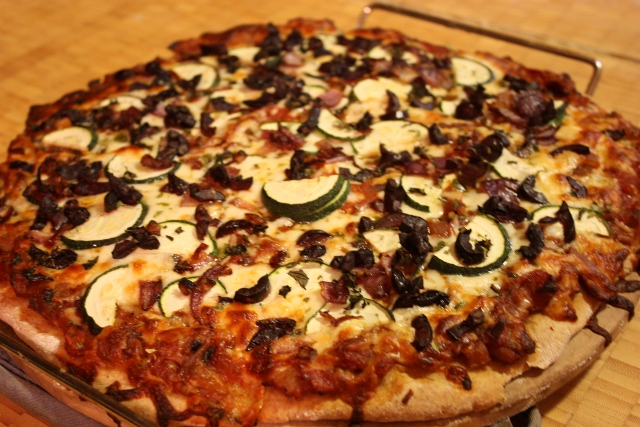
Zuchinni, shredded cheese, sauteed onions, olives, oregano, basil, leftover veggie pasta sauce, and pizza dough from the freezer


Making pizza?! I can't wait!


We put flour on the counter . . .
  . . . and Maya did not want to touch it.

We kneaded the dough . . .
  . . . and Maya did not want to touch it.


 But she sure looked cute :)

Daddy threw the dough . . .


 . . . and Maya thought it was hilarious!

When it was time to roll the dough . . .
 . . . Maya wanted to play with the radio.

When it was time to put on the sauce . . .
. . . Maya wanted to bang her spoon in the sink.

And then, finally, we found something that she liked: 

CHEESE! (Really, who doesn't like cheese?)

She hasn't learned about symmetry yet.

We added some toppings . . .

Ta-DA!!!


Yum :)


The verdict:  delicious and fun, despite the fact that Maya was semi-uninterested during much of the process.