We took this video this morning, immediately after breakfast, hence the snazzy attire.
(That's how she signs "play".)
It figures that the first word she recognizes (besides her name) is play :) Our girl is so smart!
Wednesday, June 29, 2011


Monday, June 27, 2011
Get off my terrace
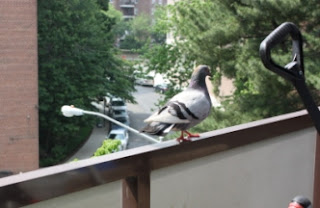
When Mama Pigeon (MP) laid eggs on our terrace, I was all excited with the nerdy science teacher hope for watching an egg hatch, and with the nerdy zoologist hope of showing my friends & family how weird looking baby pigeons are.
When they hatched, I was delighted that both chicks looked good and MP wasan attentive mom. I happily documented their first week.
When the first week was done, I remembered something . . .
. . . I hate birds.

Well, that's not totally true. I like birds in nature (or at the zoo). I like birds from far away. But birds (in my humble opinion) are terrible pets. They are not fun to own or care for. They are noisy. They eat constantly. And, they are disgustingly dirty creatures.
Mama Pigeon is pretty dumb, even by bird standards (ok, that's just not fair. Some birds are actually very smart, like crows. Crows are super smart.). She made a nest on a cement floor. Baby birds instinctively will back their little bird butts up to the edge of the nest and poop, so that the poop falls away from the nest and the nest stays clean. When the mama bird decides to lay the eggs flat on a cement floor, there's no way to keep the "nest" clean.
So, after the first week things took a turn towards "cesspool", and I had 2 options:
1. Leave everything alone. Nature would take it's course, for better or worse.
2. Start cleaning out the bird's nest on a daily basis.
Now, option 1 could result in deaths on the terrace. Even worse, it could result in the birds not growing in their feathers properly, which means that they would never fly away. I wasn't a fan of these possibilities, so now I'm cleaning up after 2 ridiculous pigeons every day.
And are they grateful? Not even a little. The younger one is a wimp and cries when I move him (or her) and the older one attacks:
Allegedly, they're about 1-2 weeks out from starting to fly. I'm waiting with bated breath.

When they hatched, I was delighted that both chicks looked good and MP wasan attentive mom. I happily documented their first week.
When the first week was done, I remembered something . . .
. . . I hate birds.

I hate you, birds.
Mama Pigeon is pretty dumb, even by bird standards (ok, that's just not fair. Some birds are actually very smart, like crows. Crows are super smart.). She made a nest on a cement floor. Baby birds instinctively will back their little bird butts up to the edge of the nest and poop, so that the poop falls away from the nest and the nest stays clean. When the mama bird decides to lay the eggs flat on a cement floor, there's no way to keep the "nest" clean.
So, after the first week things took a turn towards "cesspool", and I had 2 options:
1. Leave everything alone. Nature would take it's course, for better or worse.
2. Start cleaning out the bird's nest on a daily basis.
Now, option 1 could result in deaths on the terrace. Even worse, it could result in the birds not growing in their feathers properly, which means that they would never fly away. I wasn't a fan of these possibilities, so now I'm cleaning up after 2 ridiculous pigeons every day.
And are they grateful? Not even a little. The younger one is a wimp and cries when I move him (or her) and the older one attacks:
You can tell this video is 1-2 weeks old, because I'm giggling. (and they're still pretty small). When I'm out there now, I just mutter at them.
Allegedly, they're about 1-2 weeks out from starting to fly. I'm waiting with bated breath.

I'm only sad because you're still here, giant baby pigeons.
Sunday, June 26, 2011
Here we come, walking down the street (for real!)*
Back in November I had a similarly titled post, in which Maya got to "walk" Parker from her stroller. It was very cute. (Parker looks so much smaller in that video, by the way.)
But you know what's cuter than that?
Maya really walking Parker. She's on her 2 feet, he's on his 4 feet, and she's in charge (for better or worse). (Parker is clearly not convinced that we're actually letting her be in charge. He keeps shooting me glances like, "Really? Just stick totally with her? You don't want me to heel to you?")
Although Maya seemed pretty confident that she could open the door herself, I thought I should help her out. So here we were after we made it inside: (This one is long, but there are many cute moments, so I'm not cutting it down.)
The best parts:
0:30, when she sits at the window and kicks up her feet. Too cute.
0:40, when she calls Parker because he's starting to wander off. Show him who's in charge!
0:45, when I tell her to tell Parker to sit, and she stands up and holds up 1 finger---that's our "sit" signal :)
0:51, when she suddenly decides that it's time to move along (because, as it turns out, she remembered that on the walk home we told her we would get the mail when we got home)
1:26, because falling down is no big deal.
1:42, when she's just pulling him along on an adventure, and the size comparison of him walking behind her makes it look like she's leading a pony out to a field somewhere.
I guess the whole thing is pretty darn adorable :)
But you know what's cuter than that?
Maya really walking Parker. She's on her 2 feet, he's on his 4 feet, and she's in charge (for better or worse). (Parker is clearly not convinced that we're actually letting her be in charge. He keeps shooting me glances like, "Really? Just stick totally with her? You don't want me to heel to you?")
Although Maya seemed pretty confident that she could open the door herself, I thought I should help her out. So here we were after we made it inside: (This one is long, but there are many cute moments, so I'm not cutting it down.)
The best parts:
0:30, when she sits at the window and kicks up her feet. Too cute.
0:40, when she calls Parker because he's starting to wander off. Show him who's in charge!
0:45, when I tell her to tell Parker to sit, and she stands up and holds up 1 finger---that's our "sit" signal :)
0:51, when she suddenly decides that it's time to move along (because, as it turns out, she remembered that on the walk home we told her we would get the mail when we got home)
1:26, because falling down is no big deal.
1:42, when she's just pulling him along on an adventure, and the size comparison of him walking behind her makes it look like she's leading a pony out to a field somewhere.
I guess the whole thing is pretty darn adorable :)
Friday, June 24, 2011
Pediatric Audiology 101 (Subtitle: Why mild hearing loss can still cause speech problems)
Disclaimer #1: I am not a doctor. This is my best estimation of pediatric audiology 101. I had it checked by an audiologist, so that I don't grossly mislead you, but I don't profess to be a hearing expert.
Disclaimer #2: I am also not a real blogger. I wrote this in Word, and it took me a few days to get it as simple as possible, but I had font issues with copying & pasting it. Sorry that some parts have abrupt font changes. I don't know enough html coding to fix it.
Over the past few weeks, I’ve learned a lot about ears, hearing, and data analysis. Now I’m going to share it all, so saddle up for some scientific good times J
First things first, here’s a brief education in Pediatric Audiology. I present to you: the ear.

As you can see, the ear has three zones---outer, middle, and inner. Sound waves travel into the outer ear and cause the ear drum to vibrate, which causes the “three ear bones” to vibrate. Those vibrations then travel through the cohlea (the snail-shaped thing in the inner ear) and the cells in the cochlea send information through the auditory nerve to the brain, which tells you what you are hearing.
There are 2 families of causes of hearing loss. The first is conductive, meaning that the sound does not get properly "conducted" from the outer ear all the way to the nerve in the back of the ear system, due to a myriad of issues that could arise anywhere along the pathway. (This is common in children who might have fluid in the middle ear, ear infections, etc). The second source of hearing loss is sensorineural, meaning the the sound can be conducted through the system properly, but there is a disruption along the neural pathway.

The goal of hearing testing is to figure out the softest level that a child can detect each of the different pitches (so if your data line was right up near the top, you would have great hearing . . . if you were at the bottom, profound hearing loss.)

So the quietest sound this child can hear would be around 40 decibels, while the quietest sound that children with normal hearing could hear would be anywhere between 20 (for some kids) and -10 (for the supersonic hearing kids) decibels. You can see on the audiogram that this child has mild hearing loss in the mid-frequencies (1000 Hz) and moderate loss as the frequencies increase (2000-4000Hz).
The other color-coded zone on the audiogram is that blue/grey “speech banana”. The speech banana is represents the volumes and pitches of average conversational speech (if you want to get more technical, it represents the average conversational pitches and volumes of 2 people with normal hearing talking at about 5-7 feet apart).
Here, the child’s hearing thresholds are within the speech banana. That suggests that she has access to the sounds necessary to develop spoken language. A child with this type of hearing loss could still responds well when spoken to, even from another room, like Maya does. However, this speech may sound much softer to her, and if there is background noise it would become difficult for her to hear and understand conversational speech.
But here’s what’s really interesting. Maya’s hearing loss follows a loosely similar pattern to this made-up data, in that her hearing loss is slightly more pronounced at high frequencies. When we heard that her impairment was more significant at higher pitches, we thought “Well, what’s high pitched? Dog whistles, microwaves beeping?” What we didn’t know what that every speech sound has its own frequency. Check out the letters on the audiogram . . . you can see that the j-m-d sounds are low pitched, p-h-g are in the middle, and f-s-th are high pitched.

I’m also rethinking some of her oral-motor issues. If I say, “Maya, say ‘dada’” and she replies “Baba!” is that because she couldn’t get her mouth organized enough to say “dada” or because she misheard me?
I almost cancelled the ABR when I realized a few days beforehand that I can stand in the kitchen and say “What does a ‘B’ say?” and Maya can respond from the living room “Ba!”. I thought, surely, if she can hear that I said B (instead of D or P) from a room away, without seeing my lips move, then her hearing must be fine. But it’s not.
Make sure that you are working with an ENT that you trust, and explore the possibility of hearing impairment. Every time our ENT said “Oh, has it been 6 months? Let’s get her in for the behavioral hearing eval again.” I would roll my eyes and dread the appointment---which typically ended with a breakdown (on Maya’s part) and frustration (at spending our time in another appointment that yielded not much information). But thank goodness we all stuck with it.
Disclaimer #2: I am also not a real blogger. I wrote this in Word, and it took me a few days to get it as simple as possible, but I had font issues with copying & pasting it. Sorry that some parts have abrupt font changes. I don't know enough html coding to fix it.
Over the past few weeks, I’ve learned a lot about ears, hearing, and data analysis. Now I’m going to share it all, so saddle up for some scientific good times J
The Ear
First things first, here’s a brief education in Pediatric Audiology. I present to you: the ear.

There are 2 families of causes of hearing loss. The first is conductive, meaning that the sound does not get properly "conducted" from the outer ear all the way to the nerve in the back of the ear system, due to a myriad of issues that could arise anywhere along the pathway. (This is common in children who might have fluid in the middle ear, ear infections, etc). The second source of hearing loss is sensorineural, meaning the the sound can be conducted through the system properly, but there is a disruption along the neural pathway.
Since Maya had clean, properly fitted, functioning ear tubes (which were checked immediately prior to the ABR), we are expecting her loss to be sensorineural and *not* conductive. Additional tests that will be done on July 5 will (hopefully) rule out a conductive component. (It’s possible that there could be a combination of sensorineural and conductive components, but that will likely leave me with more questions, so I’m hoping that things will be simple. Ha ha ha.)
So that’s the anatomical side of hearing loss. Now, let’s look at some data. (Note: the data that I am about to show you is not Maya’s. It is made up. Although I share a lot, I don’t feel right about sharing her medical data---that should be her choice. When I asked her if I could post her data online, she was noncommittal. So I made up some data and my super audiologist friend created this audiogram based on it, for illustrative purposes).
The Audiogram
I present to you: an audiogram.

The numbers across the top, from 125 to 8000, represent pitch (or Frequency) of sound, going from low pitches (left) to very high pitches (right). The numbers along the side, from -10 to 120, represent hearing level in Decibels, going from very soft sounds (at the top) to very loud sounds (towards the bottom).
The goal of hearing testing is to figure out the softest level that a child can detect each of the different pitches (so if your data line was right up near the top, you would have great hearing . . . if you were at the bottom, profound hearing loss.)
Here’s the same audiogram with some color coding to make it easier to see the zones. The green zone is where children with “normal” hearing would show up. Yellow is “mild hearing loss.” Red is “moderate hearing loss”. The lines represent the child’s approximate hearing (X= her left ear, O= her right ear).

The other color-coded zone on the audiogram is that blue/grey “speech banana”. The speech banana is represents the volumes and pitches of average conversational speech (if you want to get more technical, it represents the average conversational pitches and volumes of 2 people with normal hearing talking at about 5-7 feet apart).
Here, the child’s hearing thresholds are within the speech banana. That suggests that she has access to the sounds necessary to develop spoken language. A child with this type of hearing loss could still responds well when spoken to, even from another room, like Maya does. However, this speech may sound much softer to her, and if there is background noise it would become difficult for her to hear and understand conversational speech.
But here’s what’s really interesting. Maya’s hearing loss follows a loosely similar pattern to this made-up data, in that her hearing loss is slightly more pronounced at high frequencies. When we heard that her impairment was more significant at higher pitches, we thought “Well, what’s high pitched? Dog whistles, microwaves beeping?” What we didn’t know what that every speech sound has its own frequency. Check out the letters on the audiogram . . . you can see that the j-m-d sounds are low pitched, p-h-g are in the middle, and f-s-th are high pitched.

The configuration of this child’s hearing loss would suggest that she's getting the high frequency consonants f,s, th, etc. inconsistently, or missing them entirely. So, even a child with mild hearing loss can have speech issues, because they just can't hear certain letters. (That might be an overenthusiatic use of bold/underlining, but it was a big lightbulb moment to me.) The letters in the 1000-2000 range would probably be inconsistent or unclear as well. And why is there no data below 1000 Hz? That’s because the background noise in the operating room makes it impossible to test low frequency sounds. (And this is why more testing is usually necessary after a sedated ABR, to gather data on the lower frequencies and to check on that whole conduction thing I mentioned before).
So, Back to Maya
We’ve always thought that Maya could hear well, because of her responses (“What does an H say?” “Hhhhhaa”). However, our apartment doesn’t have a lot of background noise (like school will) and kids with hearing impairment are apparently highly adaptable and skilled at compensating. The knowledge that she is hearing impaired is certainly making us re-think the times when she “stops paying attention.” Did she just decide to suddenly ignore us, or is it that she just couldn’t hear/understand the last set of directions? I’m also rethinking some of her oral-motor issues. If I say, “Maya, say ‘dada’” and she replies “Baba!” is that because she couldn’t get her mouth organized enough to say “dada” or because she misheard me?
Who knows. But you can bet your bottom dollar that I’ll be taking some good before-hearing-aids/after-hearing-aids observations and videos for comparison’s sake.
The Take-Home Message
I’ve done a lot of reflecting on the roles of parents, doctors, and various clinicians in diagnosing hearing loss. Especially in terms of the advocacy, vigilance, and thoroughness that all of the players have to bring to the table. If I had to sum it all up in one sentence, I would say this: “If at first you don’t succeed (in getting clear audiological data), try, try again.”
Also applicable, the good old “When you assume (that your child hears normally because she understands and responds to you most of the time) you make an ass out of u and me."
(Well, not me. Just you.)
Jokes aside, the big picture thing that I’ve learned is that hearing loss can be very tricky, because young kids are highly adaptable and learn to how to work around their weaknesses. So, if you have a child with speech delays, do your best to get clear audiological data.
Even if you think that your kid can hear.
Really!
I almost cancelled the ABR when I realized a few days beforehand that I can stand in the kitchen and say “What does a ‘B’ say?” and Maya can respond from the living room “Ba!”. I thought, surely, if she can hear that I said B (instead of D or P) from a room away, without seeing my lips move, then her hearing must be fine. But it’s not.
Make sure that you are working with an ENT that you trust, and explore the possibility of hearing impairment. Every time our ENT said “Oh, has it been 6 months? Let’s get her in for the behavioral hearing eval again.” I would roll my eyes and dread the appointment---which typically ended with a breakdown (on Maya’s part) and frustration (at spending our time in another appointment that yielded not much information). But thank goodness we all stuck with it.
Tuesday, June 21, 2011
And spring became the summer . . .*
Maya's nearly finished her spring cleaning . . .
![]()
![]()
And she's been re-potting the herbs for her planter garden . . .
![]()
![]()


Such a big, helping girl!
On the flip side, I spent my free time today in a very non-summery way . . . in a makeshift techno-battle station, full of extension cords, external drives, and craziness (the old laptop has to be connected to the tv to transfer files, since the monitor is not at all functional):

Two computers, an iPad, the tv, an external drive, 2 extension cords, a big water bottle, and a giant mug of green tea. It's go time.
Baby steps in the right direction---and this post, pictures and all, is being brought to you by my new computer. Hopefully by the end of the week it will be fully brought up to speed.
Sunday, June 19, 2011
Happy Father's Day! (from Maya)
To both of my grandpas, all 4 of my uncles, and most especially . . . my super daddy! He makes up the best songs, knows how to tuck me in just right, and helps me have tons of adventures. Just the other day, he took me out to play in the rain (my first time ever playing in the rain!):
After that, we took off my socks, shoes & splints and I got to run around in the rain & puddles barefoot, but the video didn't work out.
Thanks for being the best dad! I love you!
Love,
Maya (& Parker)
After that, we took off my socks, shoes & splints and I got to run around in the rain & puddles barefoot, but the video didn't work out.
Thanks for being the best dad! I love you!
Love,
Maya (& Parker)
Friday, June 17, 2011
All the cool kids make (really easy, I swear) homemade yogurt
Brief disclaimer: my computer imploded. I'm blogging from an old loaner that is working less and less as the days go by. If I disappear briefly, keep the faith---the new laptop is arriving on Weds.
Maya loves yogurt. It was the first "real" (as in something grown-ups also eat) food that she ate. We started with the Stonyfield Farms Cream Top Vanilla (yum) and then switched over to Fage whole milk greek yogurt (which is much thicker than regular yogurt) when we wanted to help her progress to thicker textures. She still eats the Fage (plain, we add honey to it) several times a week. It's a big favorite, but it's $8 for a 32oz container.
Enter the homemade yogurt idea :)
I've heard of making yogurt in the crock pot, but without knowing anyone who had really tried it I was hesitant. So when a friend took the plunge and I was able to quiz her about the results (which seemed great!) I decided to give it a shot. Here's what I did: (You can browse around online, but all of the recipes are basically the same)
Ingredients
Half a gallon of milk (*I read somewhere not to use ultrapasteurized milk. My milk is just regular pasteurized and worked fine)
1/2-3/4 cup of plain yogurt (this is where the active cultures that turn your milk into yogurt will come from)
That's it :)
(Optional ingredients: You can add vanilla or honey to sweeten the yogurt during the production process---I don't do that, and I'll explain why later. You can also add powdered milk to up the protein content and help thicken it a bit, which I do.)
Other stuff you need
A crockpot
A strainer and/or cheesecloth if you want thick, Greek-style yogurt
Directions
1. Pour milk into the crockpot (mine is 4 qts and works well). Set it on low for 2.5 hours.
![]()
2. Then, turn the crockpot off. Let it sit (off and unplugged) for 3 hours.
3. Next, remove 1-2 cups of the milk and put it in a small bowl. Add the yogurt and whisk together to combine. (This is when I also add the powdered milk---I mix in about 2/3 of a cup.)
4. Dump the small bowl back into the crockpot and stir to combine.
5. Wrap a large towel around your (unplugged) crockpot and let it sit for 8 hours. (No, I'm not kidding. This looks weird, but this is where the magic happens.)
![]()
6. Now you have yogurt!
![]()
7. If you want thick, greek-style yogurt, now you strain it. I use a strainer lined with cheesecloth (which I found at the hardware store, but my friends tell me you can also find it in the baking section of many stores). Pour the yogurt into the cheesecloth-lined colander (inside another bowl to catch the whey that drains out) and let it sit in the fridge overnight (or until you reach your desired thickness.)
![]()
Important! If you plan on making more yogurt, before you strain off the whey set aside 1/2-3/4 of a cup of the yogurt so that you have a starter for your next batch!
My review:
It's delicious and cheap! I didn't let it thicken long enough to get the same consistency as Fage, but it's good anyway. It's a little bit milder than store bought yogurt (which I prefer)---I wonder if it would get more tangy if you let it sit for longer than 8 hours (and the cultures continued to work in there). I made full fat for Maya (which I had with honey the other night for dessert) and today I'm making a pot of skim for Dave &I (I'll update on how the skim turns out after it is strained, which will be overnight tonight).
The time commitment isn't that bad---you have to start it, be around in 2.5 hrs, and then be around 3 hours after that. Takes a minimum amount of mental math and planning.
It's a lot of yogurt for the price of a half gallon of milk, and you get to control the thickness and quality of ingredients.
Other thoughts:
This stuff has endless possibilities . . . it's not like you're just strictly making yogurt, it's like making a creamy dairy product. You can sweeten it with honey, fruit, or fruit purees----although I read reviews online that said it's better to do that to single servings because if you mix in all the fruit up front the yogurt loses a little bit of its thickness.
You could keep it on the savory side by using it as a sour cream substitute. If you let it thicken a lot, you would end up with yogurt cheese. Although it may sound questionable, it's kind of like a cream cheese spread---for bread, crackers, bagels, etc. I imagine you could get creative by mixing spices, chives, etc into the yogurt cheese---homemade cream cheeses? Super fancy!
About the whey:
Allegedly the whey (which is the liquid that drains off if you decide to strain the yogurt) is a great substitute for buttermilk. I don't think I've ever cooked anything that required buttermilk, but if you do (I've heard that pancakes and other baked good recipes often use it) then try it out. I read that you can also freeze the whey to use it later---if you do that, I would freeze it in ice cube trays for easy measuring and defrosting later. This blogger also says you can add the whey to smoothies for a nutritional boost.
In conclusion
Not only is making yogurt cheap, but I feel like a total badass homemaker. It makes me want to wear a little apron skirt (well, I'd have to buy an apron skirt first---but then I would wear it) and heels in the kitchen. I wish I had a t-shirt that says "I make my own yogurt", for real. I think if you do it, you get serious bragging rights.
Maya loves yogurt. It was the first "real" (as in something grown-ups also eat) food that she ate. We started with the Stonyfield Farms Cream Top Vanilla (yum) and then switched over to Fage whole milk greek yogurt (which is much thicker than regular yogurt) when we wanted to help her progress to thicker textures. She still eats the Fage (plain, we add honey to it) several times a week. It's a big favorite, but it's $8 for a 32oz container.
Enter the homemade yogurt idea :)
I've heard of making yogurt in the crock pot, but without knowing anyone who had really tried it I was hesitant. So when a friend took the plunge and I was able to quiz her about the results (which seemed great!) I decided to give it a shot. Here's what I did: (You can browse around online, but all of the recipes are basically the same)
Ingredients
Half a gallon of milk (*I read somewhere not to use ultrapasteurized milk. My milk is just regular pasteurized and worked fine)
1/2-3/4 cup of plain yogurt (this is where the active cultures that turn your milk into yogurt will come from)
That's it :)
(Optional ingredients: You can add vanilla or honey to sweeten the yogurt during the production process---I don't do that, and I'll explain why later. You can also add powdered milk to up the protein content and help thicken it a bit, which I do.)
Other stuff you need
A crockpot
A strainer and/or cheesecloth if you want thick, Greek-style yogurt
Directions
1. Pour milk into the crockpot (mine is 4 qts and works well). Set it on low for 2.5 hours.

2. Then, turn the crockpot off. Let it sit (off and unplugged) for 3 hours.
3. Next, remove 1-2 cups of the milk and put it in a small bowl. Add the yogurt and whisk together to combine. (This is when I also add the powdered milk---I mix in about 2/3 of a cup.)
4. Dump the small bowl back into the crockpot and stir to combine.
5. Wrap a large towel around your (unplugged) crockpot and let it sit for 8 hours. (No, I'm not kidding. This looks weird, but this is where the magic happens.)

6. Now you have yogurt!

It tastes better than it looks, I promise. I don't think any type of yogurt photographs well. At least not with a cell phone camera and kitchen lighting.
7. If you want thick, greek-style yogurt, now you strain it. I use a strainer lined with cheesecloth (which I found at the hardware store, but my friends tell me you can also find it in the baking section of many stores). Pour the yogurt into the cheesecloth-lined colander (inside another bowl to catch the whey that drains out) and let it sit in the fridge overnight (or until you reach your desired thickness.)

(dramtatic reenactment--there's not yogurt in here, but you get the idea)
Important! If you plan on making more yogurt, before you strain off the whey set aside 1/2-3/4 of a cup of the yogurt so that you have a starter for your next batch!
My review:
It's delicious and cheap! I didn't let it thicken long enough to get the same consistency as Fage, but it's good anyway. It's a little bit milder than store bought yogurt (which I prefer)---I wonder if it would get more tangy if you let it sit for longer than 8 hours (and the cultures continued to work in there). I made full fat for Maya (which I had with honey the other night for dessert) and today I'm making a pot of skim for Dave &I (I'll update on how the skim turns out after it is strained, which will be overnight tonight).
The time commitment isn't that bad---you have to start it, be around in 2.5 hrs, and then be around 3 hours after that. Takes a minimum amount of mental math and planning.
It's a lot of yogurt for the price of a half gallon of milk, and you get to control the thickness and quality of ingredients.
Other thoughts:
This stuff has endless possibilities . . . it's not like you're just strictly making yogurt, it's like making a creamy dairy product. You can sweeten it with honey, fruit, or fruit purees----although I read reviews online that said it's better to do that to single servings because if you mix in all the fruit up front the yogurt loses a little bit of its thickness.
You could keep it on the savory side by using it as a sour cream substitute. If you let it thicken a lot, you would end up with yogurt cheese. Although it may sound questionable, it's kind of like a cream cheese spread---for bread, crackers, bagels, etc. I imagine you could get creative by mixing spices, chives, etc into the yogurt cheese---homemade cream cheeses? Super fancy!
About the whey:
Allegedly the whey (which is the liquid that drains off if you decide to strain the yogurt) is a great substitute for buttermilk. I don't think I've ever cooked anything that required buttermilk, but if you do (I've heard that pancakes and other baked good recipes often use it) then try it out. I read that you can also freeze the whey to use it later---if you do that, I would freeze it in ice cube trays for easy measuring and defrosting later. This blogger also says you can add the whey to smoothies for a nutritional boost.
In conclusion
Not only is making yogurt cheap, but I feel like a total badass homemaker. It makes me want to wear a little apron skirt (well, I'd have to buy an apron skirt first---but then I would wear it) and heels in the kitchen. I wish I had a t-shirt that says "I make my own yogurt", for real. I think if you do it, you get serious bragging rights.
Wednesday, June 15, 2011
A summary of my worst thoughts this week
(Well, with a title like that, who wouldn't want to jump right into this one?)
I've spent a lot of time over the past week thinking about, talking about, emailing about and calling people about all-things-audiology/hearing-aid related. It's overwhelming. And I have some mixed emotions about the whole situation.

My dual overriding feelings are those of excitement and anxiety. I'm anxious about the extra testing we have coming up, and the process of molding and getting the hearing aids. About getting her acclimated to them (I can't even keep mittens on this kid . . . I imagine the first few days will be a miserable repetition of "No, Maya, leave those in, please" times 1,000,000). But I'm secretly really excited, too . . . as we've gotten some more data, it's clear that there are some letter sounds that she is probably totally unable to hear in a normal conversation. I can't wait for her to hear more of what is going on around her, and to start possibly picking up on (and mimicking?!) those new sounds.
Next came the sadness. Well, chronologically the sadness came before the excitment . . . but in terms of residual emotions, the sadness has been bumped to third. It took a day or two to get on the "Ok, hearing aids!" train . . . and then somehow in my head the hearing aids were like the walker. They would be something to use to help her out, until she could gain the necessary skills and "catch up" (by walking on her own, or by making sounds and talking on her own). In my mind the hearing aids would be around for 3 or 4 years, she would be talking, and they would retire to a photograph and a blog entry about how "Someday I won't remember the reality of living with with hearing aids---I'll kind of remembering cleaning them and managing the batteries and laying them carefully out when she goes to sleep, but I won't really remember."
But while chatting with Amy (my super audiologist friend) I mentioned something about the long term plan, like "So how long does a kid with data similar to Maya's use hearing aids for?" and she said "The easiest way to think about them is kind of like glasses----if your vision needs help, you wear glasses/contacts to make it better. For children with hearing impairment, the hearing aids make the hearing better. She may use them through all of her adult life."
(and I sat down and put my head on my desk)
Forever?
(that was another game changing moment for me)
So I started working at mentally re-moving into Acceptance (first it was acceptance of the she-will-wear-hearing-aids reality, and now, a few days later, this she-will-wear-hearing-aids-forever reality). At the same time, I fought the Guilt again.
I knew that guilt was waiting for me in the recovery room, and I had my apologies to Maya ready in my back pocket the night before. But once I knew the hearing aids were coming, it hit again, and I thought, "You can't talk. And in some part, your inability to communicate (which must be terribly frustrating) is due to the fact that you can't hear us clearly. You've sent signs and signals and we should have pushed to do this sooner. I'm sorry."
Oh, and wait . . . let me get a jump start on the ones to come . . .
I'm sorry that we have a 3 hour audiology appointment on the horizon---tests and more tests and squirting strange goo into your ears that you won't understand is going to help in a few weeks.
I'm sorry that you will have to have something in your ear all-the-live-long-day to hear us better.
I'm sorry that you will likely have to explain your hearing aids to friends, teachers, strangers. Or that people may stare.
I'm sorry that you'll get used to hearing us clearly, but then when we go to the pool (which you love) we'll have to take them off and you will hear muffled, garbly conversation again.
I'm double sorry for any extra time we spent waiting and double-checking your ears before putting tubes in. Adding the fluid that you had there for 6 months on top of your hearing loss was adding insult to injury. You already struggled to hear, and then you were underwater on top of that.
-sigh-
And there's one more little nagging feeling----the fear. The fear slice was small enough that as it started to rear up with its "what if"s I managed to push it back down. But as the days passed by fear kept surfacing and I would tear up randomly and I thought to myself, Well I think I just have to sink into this, embrace the crazy and have a good cry and come out on the other side thinking "Well, if that's the worst, at least I've already looked it in the eye". And so, yesterday after I put Maya down for her nap I let myself unravel.
Here's the thing . . . her ears have always been weird. Her L ear was questionable at birth, and at a month old, and then declared normal (the first time that we had an ABR done, at 2.5 months old). Then it was questionable, then probably normal, then not-quite-sure. The right ear has been mostly normal all along. And now this ABR shows mild & moderate (more on the data in a few days) loss. So, while the mom part of me thinks "How frustrating that we could never clearly decipher this until now. It's so aggravating that our prior tests were unclear, and that the first ABR may not have been done correctly. But at least now we know exactly where her loss is" . . . the scientific part of me thinks "The 1st ABR said both ears were normal (2008). Many of our previous tests have indicated that the R ear was normal, the L borderline (2009-2010). The second ABR shows mild & moderate hearing loss (2011)."
So, what if it's progressive?
What if she's losing her hearing?
What if we are getting ever-so-slightly quieter and quieter?
(and then the flood of irrational, panicked thoughts set in, and I rode the wave)
I don't want her to lose my voice. To have whispers slip away, and the higher notes of the adorable songs that Dave is constantly making up drop out. What if she can't hear the birds singing on our walks anymore . . . will she think that they just stopped singing?
Will she get angry that we're getting quieter and think that it's something we're doing on purpose?
I have a mental flash of her in this video laughing at the dogs, and I think about how she still laughs and laughs when dogs bark at the dog park. I wonder, if she was to totally lose her hearing, how long would she remember sounds for? How long before she couldn't recall a barking dog, or remember the melody of a song?
How long before she wouldn't remember what I sounded like when I shrieked "Maya! Get back here!" and chased her giggling self, or whispered "I love you, Maya" in the middle of a big hug?
So, there were some tears.
And that was yesterday's small mental breakdown. It was dramatic and self-indulgent, but cleansing. The most effective way for me to get rid of a nagging, scary feeling is to totally let it in, sink into the worst of it, turn it around and look at it from every angle, and then step away and see that it's not as bad in the light as it seemed in the dark.
The reality of the situation is that progressive hearing loss in young kids is highly unlikely. (On the flip side, it's not super common to have the mysterious undiagnosed genetic stuff that we have going on . . . so "rare" isn't as calming to me now as it would have been a few years ago.) Maya's hearing loss is mild (like I said, more on the data details later) so she can probably hear us (and birds and dogs and all that jazz) pretty well---it's just not as clear as it should be.
Truly, I am still worried about the possibility that her hearing loss is progressive. But even if it were, and it was progressing to the point of really not hearing at all, I would guess that our enlightened technological age probably offers many crazy solutions (higher powered hearing aids, cochlear implants, etc) that would prevent her world from going silent. (Which I know it's not. It's just comforting to confront the absolutely highly unlikely worst case scenario and say "I think there's probably a solution for that, so it would be ok, regardless".)
Whew.
To tie this all up, I'm actually feeling pretty good now. Excited to get this ball rolling, nervous about how much she'll cooperate for her upcoming testing/molding appointment, and super duper excited/curious to watch her hear things differently once she gets the hearing aids (which will likely be happening the last week in July.)
:)
I've spent a lot of time over the past week thinking about, talking about, emailing about and calling people about all-things-audiology/hearing-aid related. It's overwhelming. And I have some mixed emotions about the whole situation.

My dual overriding feelings are those of excitement and anxiety. I'm anxious about the extra testing we have coming up, and the process of molding and getting the hearing aids. About getting her acclimated to them (I can't even keep mittens on this kid . . . I imagine the first few days will be a miserable repetition of "No, Maya, leave those in, please" times 1,000,000). But I'm secretly really excited, too . . . as we've gotten some more data, it's clear that there are some letter sounds that she is probably totally unable to hear in a normal conversation. I can't wait for her to hear more of what is going on around her, and to start possibly picking up on (and mimicking?!) those new sounds.
Next came the sadness. Well, chronologically the sadness came before the excitment . . . but in terms of residual emotions, the sadness has been bumped to third. It took a day or two to get on the "Ok, hearing aids!" train . . . and then somehow in my head the hearing aids were like the walker. They would be something to use to help her out, until she could gain the necessary skills and "catch up" (by walking on her own, or by making sounds and talking on her own). In my mind the hearing aids would be around for 3 or 4 years, she would be talking, and they would retire to a photograph and a blog entry about how "Someday I won't remember the reality of living with with hearing aids---I'll kind of remembering cleaning them and managing the batteries and laying them carefully out when she goes to sleep, but I won't really remember."
But while chatting with Amy (my super audiologist friend) I mentioned something about the long term plan, like "So how long does a kid with data similar to Maya's use hearing aids for?" and she said "The easiest way to think about them is kind of like glasses----if your vision needs help, you wear glasses/contacts to make it better. For children with hearing impairment, the hearing aids make the hearing better. She may use them through all of her adult life."
(and I sat down and put my head on my desk)
Forever?
(that was another game changing moment for me)
So I started working at mentally re-moving into Acceptance (first it was acceptance of the she-will-wear-hearing-aids reality, and now, a few days later, this she-will-wear-hearing-aids-forever reality). At the same time, I fought the Guilt again.
I knew that guilt was waiting for me in the recovery room, and I had my apologies to Maya ready in my back pocket the night before. But once I knew the hearing aids were coming, it hit again, and I thought, "You can't talk. And in some part, your inability to communicate (which must be terribly frustrating) is due to the fact that you can't hear us clearly. You've sent signs and signals and we should have pushed to do this sooner. I'm sorry."
Oh, and wait . . . let me get a jump start on the ones to come . . .
I'm sorry that we have a 3 hour audiology appointment on the horizon---tests and more tests and squirting strange goo into your ears that you won't understand is going to help in a few weeks.
I'm sorry that you will have to have something in your ear all-the-live-long-day to hear us better.
I'm sorry that you will likely have to explain your hearing aids to friends, teachers, strangers. Or that people may stare.
I'm sorry that you'll get used to hearing us clearly, but then when we go to the pool (which you love) we'll have to take them off and you will hear muffled, garbly conversation again.
I'm double sorry for any extra time we spent waiting and double-checking your ears before putting tubes in. Adding the fluid that you had there for 6 months on top of your hearing loss was adding insult to injury. You already struggled to hear, and then you were underwater on top of that.
-sigh-
And there's one more little nagging feeling----the fear. The fear slice was small enough that as it started to rear up with its "what if"s I managed to push it back down. But as the days passed by fear kept surfacing and I would tear up randomly and I thought to myself, Well I think I just have to sink into this, embrace the crazy and have a good cry and come out on the other side thinking "Well, if that's the worst, at least I've already looked it in the eye". And so, yesterday after I put Maya down for her nap I let myself unravel.
Here's the thing . . . her ears have always been weird. Her L ear was questionable at birth, and at a month old, and then declared normal (the first time that we had an ABR done, at 2.5 months old). Then it was questionable, then probably normal, then not-quite-sure. The right ear has been mostly normal all along. And now this ABR shows mild & moderate (more on the data in a few days) loss. So, while the mom part of me thinks "How frustrating that we could never clearly decipher this until now. It's so aggravating that our prior tests were unclear, and that the first ABR may not have been done correctly. But at least now we know exactly where her loss is" . . . the scientific part of me thinks "The 1st ABR said both ears were normal (2008). Many of our previous tests have indicated that the R ear was normal, the L borderline (2009-2010). The second ABR shows mild & moderate hearing loss (2011)."
So, what if it's progressive?
What if she's losing her hearing?
What if we are getting ever-so-slightly quieter and quieter?
(and then the flood of irrational, panicked thoughts set in, and I rode the wave)
I don't want her to lose my voice. To have whispers slip away, and the higher notes of the adorable songs that Dave is constantly making up drop out. What if she can't hear the birds singing on our walks anymore . . . will she think that they just stopped singing?
Will she get angry that we're getting quieter and think that it's something we're doing on purpose?
I have a mental flash of her in this video laughing at the dogs, and I think about how she still laughs and laughs when dogs bark at the dog park. I wonder, if she was to totally lose her hearing, how long would she remember sounds for? How long before she couldn't recall a barking dog, or remember the melody of a song?
How long before she wouldn't remember what I sounded like when I shrieked "Maya! Get back here!" and chased her giggling self, or whispered "I love you, Maya" in the middle of a big hug?
So, there were some tears.
And that was yesterday's small mental breakdown. It was dramatic and self-indulgent, but cleansing. The most effective way for me to get rid of a nagging, scary feeling is to totally let it in, sink into the worst of it, turn it around and look at it from every angle, and then step away and see that it's not as bad in the light as it seemed in the dark.
The reality of the situation is that progressive hearing loss in young kids is highly unlikely. (On the flip side, it's not super common to have the mysterious undiagnosed genetic stuff that we have going on . . . so "rare" isn't as calming to me now as it would have been a few years ago.) Maya's hearing loss is mild (like I said, more on the data details later) so she can probably hear us (and birds and dogs and all that jazz) pretty well---it's just not as clear as it should be.
Truly, I am still worried about the possibility that her hearing loss is progressive. But even if it were, and it was progressing to the point of really not hearing at all, I would guess that our enlightened technological age probably offers many crazy solutions (higher powered hearing aids, cochlear implants, etc) that would prevent her world from going silent. (Which I know it's not. It's just comforting to confront the absolutely highly unlikely worst case scenario and say "I think there's probably a solution for that, so it would be ok, regardless".)
Whew.
To tie this all up, I'm actually feeling pretty good now. Excited to get this ball rolling, nervous about how much she'll cooperate for her upcoming testing/molding appointment, and super duper excited/curious to watch her hear things differently once she gets the hearing aids (which will likely be happening the last week in July.)
:)
Monday, June 13, 2011
Poultry in the alphabet hallway
Side note: I don't know why the last 4 pictures here are sideways. I'll try reuploading them again later and hope that blogger is working better. For now, turn your computer or your head 90 degrees to the left. If you have a desktop, I suggest turning your head.
I've been in major DIY mode the past few days. Maya & I took a trip to Lakeshore over the weekend, where I had to restrain myself from buying up every alphabet/sight words/colors/shapes/numbers product that they have. I bought a bunch of stuff and walked around snapping cell phone photos of everything that made me think "I could make that at home.".
(Side philosophical note: I am not a huge proponent of forced education on little kids. I think toddlers should get to play like toddlers. But Maya loves letters . . . and she loves words. Her favorite hobby this week is sitting on the floor and reading magazines, pointing and yelling at the pages that have ads with giant font letters. So if she likes letters and words, then I'm going to surround her with them. For as long as she is nonverbal, she will be underestimated by the masses, and I'm going to help her get as friggin' smart as she can, so that she will surprise and enlighten many people . . . teaching them not to judge a book by its cover, for sure.)
Anyway, I've been busy with my trusty laminator:


As I walked past the kitchen, I noticed that it was looking very industrious today as well. Those are some herbs from a weekend fair that I need to repot, a rice cooker that was making rice for tonight's dinner, and my crockpot, in which I'm attempting to make homemade yogurt. If it works out, it will be a delicious money saver----but I'm not counting on anything until I taste the first batch.

Maya was delighted to see them again, especially was one frisky duckling started tickling her:


Virginia got them to follow her into the hallway . . .

. . . and when they decided to all lay down, we said "Maya, look, the ducks are tired. They're resting." . . . so she decided that it would be best to lay down and rest, too.

I've been in major DIY mode the past few days. Maya & I took a trip to Lakeshore over the weekend, where I had to restrain myself from buying up every alphabet/sight words/colors/shapes/numbers product that they have. I bought a bunch of stuff and walked around snapping cell phone photos of everything that made me think "I could make that at home.".
(Side philosophical note: I am not a huge proponent of forced education on little kids. I think toddlers should get to play like toddlers. But Maya loves letters . . . and she loves words. Her favorite hobby this week is sitting on the floor and reading magazines, pointing and yelling at the pages that have ads with giant font letters. So if she likes letters and words, then I'm going to surround her with them. For as long as she is nonverbal, she will be underestimated by the masses, and I'm going to help her get as friggin' smart as she can, so that she will surprise and enlighten many people . . . teaching them not to judge a book by its cover, for sure.)
Anyway, I've been busy with my trusty laminator:

I totally love one project that I did today. I bought alphabet cards, trimmed them so that I could squeeze in 2 per laminating pouch, cut them out, and lined the hallway with them (at Maya's eye level, not mine). (They have to be laminated because otherwise they would likely be crumpled/bent/torn up at some point)

laid out and ready to tape up

One side done

She was pretty excited to wake up from her nap and see a letter-filled hallway :)
As I walked past the kitchen, I noticed that it was looking very industrious today as well. Those are some herbs from a weekend fair that I need to repot, a rice cooker that was making rice for tonight's dinner, and my crockpot, in which I'm attempting to make homemade yogurt. If it works out, it will be a delicious money saver----but I'm not counting on anything until I taste the first batch.

And Maya had a typical 4-therapy Monday. During the day's last session, I shot a little video. Just typical therapy . . .
Oh yeah, except the ducklings were back. And big enough now that they just waddled free. Dave came home, got changed, peeked into the living room and said "There are ducks? Wandering around our apartment?" Seems about right, I think.

Hey! That's my foot!

Oh, duckie, that is just too tickly!
Virginia got them to follow her into the hallway . . .

. . . and when they decided to all lay down, we said "Maya, look, the ducks are tired. They're resting." . . . so she decided that it would be best to lay down and rest, too.

Goodnight, ducks. I'm right here if you want to cuddle.
Sunday, June 12, 2011
Week one, pigeon-style
One of the pigeon chicks is 1 week old today (the lazier one will be one week old tomorrow). Here's a glimpse into pigeon growth & development in the first week:
Day 1:

Day 2:


Day 4:




Day 1:

Tiny enough to fit in an egg, with my rings
Day 2:

The lazy baby hatched, too!
Day 3:
Still little enough to fit on my lens cap
Day 4:

Two chick butts sticking out from under MP

See the first hints of grey by the shoulder blade? Grey feathers are soon to come
Day 5:
Maya comes to meet the pigeons . . . which MP does not like:

Hrmphh. I'm going to wait over here.

Mama! There's a pigeon over there!

The yellow baby feathers are getting more and more sparse, and I see grey down the wings and on the chest now. And their eyes are open!

Maya: There are baby birds! Right over there!
Parker: I wish I could see :(
Day 7: (That's today)

Look at the little flight feathers coming in, all down the wing!

See my engagement ring? (Directly in front of the bird on your right). Man, birds grow fast!
The Ring Side-by-Side:
Subscribe to:
Posts (Atom)