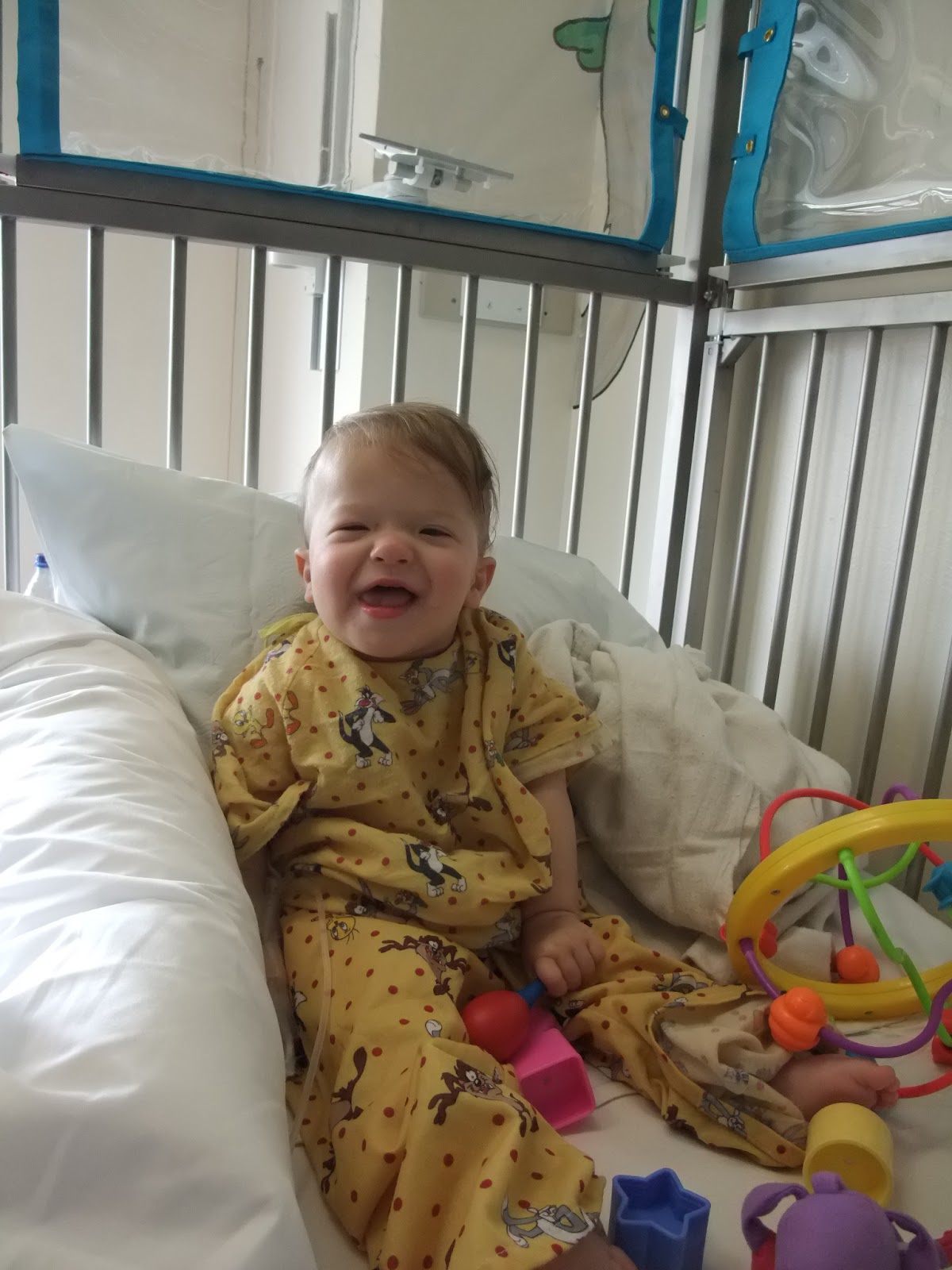
Thursday, April 19, 2012

Every so often it's time to cry again

Maya arrived home the other day with one thing on her mind: the school bus.  She was saying “school bus” with her talker, she pointed to the picture of the bus that hangs in the alphabet hallway (with the letter B), she told me “buh!” several times, and she kept demanding that we sing “wheels on the bus.”  Her method of demanding was very cute--she made sure that she had our attention and then rolled her arms round-and-round, just like in the song.  We sang, she acted it out, the song ended, she was delighted and wanted more.  Good times.

But I didn’t know why she was so suddenly enamored with wheels-on-the-bus, and it nagged at me.  Was she excited to be traveling on the school bus again after her week off?  Were they reading about a bus at school?  Does someone else sing her that song?

It was obvious from the way that she lit up when we started to sing that she was making some connection, and she couldn’t tell me what is was.  So after she went to sleep I emailed her teacher, Laura.  First, I let her know that Maya was newly obsessed with wheels-on-the-bus, and that spinning her arms translates as “let’s sing WOTB!”  Then I asked if they had done anything with that song at school.

I got the reply the next morning (I’m paraphrasing): That’s too funny!  Actually, I sang it to her yesterday at school, and then we all sang it later as a class!

I smiled reading it, understanding how much Maya must have enjoyed acting out the song with her friends, and how excited she was to keep doing it at home with us.   Then I started to cry.

God, how I hate that she can’t talk.

I hate that in order to figure out that they sang wheels-on-the-bus we had to go through a crazy multi-step guessing game: Maya acts out round-and-round, I guess that’s she saying wheels-on-the-bus and start to sing.  She lights up, so I know that I’m right. I sing and she does the motions and she is more delighted than usual, so I take her excitement as a clue that something more is going on.  I email the (luckily cooperative) teacher, who doesn’t mind my guessing games, and wait to hear back to gather more clues.  Finally, I find out that she sang it at school, and now I wait for the rest of the day to go by so that when I see her again I can say, “Maya, I talked to Laura!  She told me that you sing wheels-on-the-bus at school!”  Mystery solved!  High fives all around!  24 hours from start to finish.

Or . . .if she could talk . . . she could say “Wheels on the bus!” and we could sing together and I could say “Did someone sing that today at school?” and she could say “Laura sings wheels on the bus!” and then we could have a snack.  4 minutes, maybe, from start to finish.

I hate that I might be missing other hints that she tries to give me, other things that she wants to share.   I speak for her constantly, making connections and guessing.  When she enthusiastically points out a whale in a book, I say “Oh,  a whale!  That’s like the big whale that we saw at the museum!” . . . but what if she’s pointing at the whale because it’s blue? Or because a boy in her class wore a shirt with a whale on it today?  Or because they’re studying the letter W at school and read a whale book earlier this week?  How can I keep talking for her, when I’m really just taking my best shot at guessing what she’s trying to say?

I hate that it’s so hard for her.  And for us.  And while I love her easy (well, mostly easy) personality and I’m eternally grateful that she doesn’t seem to sense the unfairness of her situation yet, I’m so angry on her behalf.  I resist the urge to get down on my knee and look her in the eyes and say “this isn’t fair to you, you know.  Other kids have it so easy and you have to work so hard and even then sometimes I just don’t understand and it’s not your fault and I can’t do anything to help and I’m sorry.”  I try to be happy that she (mostly) doesn’t care yet because I know that someday she will and that will be another crushing thing.

I hate that for us to communicate there is a multi-modal full body exchange that needs to happen.  I hate that I have to guess.  I hate that I’m probably wrong a fair number of times and I don’t know it.  I hate when she gets angry and cries/whines/yells at us (which happens at least once a day) because we don’t understand and she doesn’t know how to make us understand.   I hate that here I am again, three years into all of this stuff, writing with a crumpled pile of used tissues on the floor next to me. 

Every so often it's time to cry again.

At least now I have three years’ worth of experience behind me . . . enough to know what happens next.  I’ve sang this song before, many times now.  I will cry angry tears and then they will change to sad tears and then I will be numb.  And when the numbness fades I’ll take the energy that’s beneath it and, with new gusto, throw myself into working on communication stuff.  Oral motor exercises and making Maya request things with sounds and working more and more closely with the talker and Speak for Yourself so that it will continue to become increasingly incorporated into the way she initiates communication.  We have a lot of tools and a lot of knowledge and have to keep doing the hard work of making it stick.  There will be productivity and progress until I reach a new breaking point, and then we will start again. 


Postscript: I finished writing this at 2:55pm. At 3:15 Maya came home and we got the mail, and a prototype keyguard for the Speak for Yourself app arrived, which is fantastic and will definitely help with Maya’s communication accuracy via the talker.  At 4:10 I became sure (after a few days of debating) that I’m starting to feel the baby kick.  So, I guess sometimes you get lucky and the time to cry passes more quickly than you would expect. 


Thursday, April 12, 2012

Undiagnosed Children's Day is tomorrow!

Tomorrow is Undiagnosed Children's Day!

This may lead to some questions, such as, what is Undiagnosed Children's Day, and why are you only telling us about it a few short hours before the big event?  I'll give you the long answer to the first one, but for the second let's just say that there was a bit of date confusion and I thought I had an extra week to get my act in gear (oops). 

What is Undiagnosed Children's Day?
Undiagnosed Children's Day is a day where you get to support (and, if you're feeling motivated, raise awareness) of the kids that you know (like Maya) who are undiagnosed.  It's an awareness day that was invented last year by another blogger, Heather of Team Aidan, whose son has an undiagnosed developmental disability. 

Why did Heather invent an awareness day?
A year ago, Heather wrote the post that kicked off Undiagnosed Children's Day, and she started it like this:

When people ask me for Aidan’s diagnosis, I say he has development delays and hypotonia (low muscle tone.) Those are words that get you nowhere. When he turned 6, he lost some services because that diagnosis was no longer valid. Happy 6th Birthday, poof, your disability is gone. No wait, the disability is still there but your services aren’t. In school he is labeled as multi-handicapped. That only works for school. Many agencies have different qualifying criteria. Don’t try moving to a different state because they may require a different name.

Yeah.  Getting older without a diagnosis is really difficult (she goes on to qualify, by the way, that having a diagnosis comes with its own pros and cons---we're certainly not saying that having a diagnosis is a cakewalk, just that it sure can be handy when you need it).  It's something that would keep me up at night, if I allowed myself to think about it for more than two minutes at a time.

There are other challenging things about not having a diagnosis, too.  One that gets under my skin is the skepticism that can come from inquiring minds.  Maybe someone that has a child with disability and is asking about Maya, or maybe it's from someone within the education/services world, or maybe we're visiting a new doctor . . . and when I say "She has a undiagnosed genetic syndrome" there's a flash, a little lightening bolt that flits through many of their eyes.  Some hide it better, while some fully commit with a raised eyebrow, but there's often a flicker of Oh, come on, don't beat around the bush, just tell me or Haven't you even taken her to get checked out or If it's 'undiagnosed' then how do you know it's genetic or whatever.   

You know what's especially biting about those skeptical folks?

I think I could have been one of them.

I'm a science girl. (I was a zoology major, a science teacher, an EMT, I have a masters in teaching science, and my mom's a nurse.  I was always kind of biology-nerdy, even before Maya.)  I like data and tests.  Had someone told me that their child was undiagnosed I'm fairly sure that I would have been very curious and asked a lot of questions (hopefully politely, but who knows).  My level of skepticism probably would have depended on what I thought of the parents and their capability to find the right doctors and push for tests and advocate and whatever.  My outer opinion would have been sympathetic. My inner voice would wonder when they would be able to get the diagnosis-------when, not if, because this is 2012 after all, and we're sequencing DNA and all that jazz and how could there just not be a test to run that would bring the answer in?

This is why a little awareness would be helpful.  Because I would have been skeptical of someone in my own position.  Because despite being a graduate-degree-educated-big-city-science-nerd, I had never been aware of the limitations of medicine and science in their ability to diagnosis children who are struggling with nameless syndromes or disorders. 

What does one do to participate in Undiagnosed Children's Day?
Wear blue!

That's it.

Ok, that's not totally it.  First, wear blue.  Then, if you can, share something about Undiagnosed Children's Day---on your Facebook, via email, with a tweet, dropped into a phone conversation, however you want.   You can share this post from Heather, or her original Undiagnosed Children's Day post, or share this post that you're reading right now.  Share a picture of yourself rocking out in blue, and let people know why you're wearing it.

And if you're wearing blue, share it with us, too!  Because if there's one thing that's tough about the undiagnosed world, it's the going-solo-ness of it all.  Heather wrote:

The whole “undiagnosed developmental disability” thing happened slowly, much like a gentle slope you didn’t realize you were on until you hit the bottom. The bottom: left behind by state workers who need to check a box, left behind by the moms who said, “but you must know what caused it,” left behind by the support groups who rally around kids with CP or Down Syndrome (ok, to be fair, I’ve met awesome moms who have asked me to come to their groups anyway), left behind by foundations that research specific diseases. Alone.

If I had had Maya 20 years ago, pre-internet, I would have been lost.  If not for the ability to seek out bloggers, therapists, AAC specialists, and other parents (and then badger them via email, FB, and twitter until they answer my questions and beg me to leave them alone) I'm really not sure what I would have done.  I push into other online communities and try to glean what might work for us, but there is a loneliness that comes with not having a group that totally gets it.  Even the undiagnosed community is so hugely variable that it's tough to find a great fit.  We're so lucky to have wonderful families, supportive friends, and online allies . . . but there are many other undiagnosed families who don't have that, who just wish more people understood.  And tomorrow, when test results come in to doctor's offices around the world and more parents hear "The results were normal.  Let's just wait and see, and check back in 6 months." our ranks will grow.

So tomorrow, wear blue.  And share Undiagnosed Children's Day, and the fact that even with today's advances in medicine, technology, and science, there are large numbers of families who are still looking for an answer.


Tuesday, April 10, 2012

Easter & the zoo

If you aren't following the blog on Facebook, you've missed out on a few things recently.  First, I've put up some cute pictures (some of which you'll see here).  Second, today I posted a (not-at-all-graphic) play by play of the excitement that we had during day 1 of our attempt at potty training.  Third, I spent Saturday morning in the emergency room because I couldn't breathe, and it turned out that I had croup (aka laryngotracheitis aka no-one-gets-that-after-they're-like-5-years-old, right?). 

Between trying to recover, allergy attacks, potty training boot camp (well, not really), and school being closed for the week, I don't have the time to really write.  Instead, pictures:


Collecting eggs is fun . . .

But not as fun as BUBBLES!

(Parker was a big fan of the bubbles, too.  He was like a bubble pac-man.)


Then, on Monday we went to the zoo . . .

Impressively, her love for alligators remains as strong as ever, months after it started.  She just adores them.

Alligators!  I see them!


This was when she saw that one was swimming towards her :)


Thursday, April 5, 2012

Another (and final) link post

This week the PRC & SCS v. Speak for Yourself case, and Maya's connection to the story, appeared on the website of TIME Magazine.  It was a good, fair, well-balanced article, and included an adorable picture and cute story about Maya.  (I'm sharing it here for the readers of the blog who might not have seen it on FB, but from now on you'll just have to go check the links page for news, since I don't want the blog to turn into all-court-case-all-the-time.)

Also, the links page has been updated.


Watching these stories pop up over the past two weeks has been a bit surreal, and also kind of taxing.  I learned an interesting lesson---once you tell your story, it will get retold . . . and some of those re-tellers will be more concerned about accuracy than others.  I've seen articles that have asserted that Maya has autism and that she is deaf (neither are true).  I've seen people explain that we can't use a device because they are too heavy (which is only a very small reason that we didn't chose a device).  I've seen articles that claim that PRC & SCS are patent trolls and that PRC, SCS, and Apple are all evil companies (I do not agree with any of these statements).  Yet my name appears in most of these articles.  That's frustrating.

You know what else I learned?  Maya is allegedly ready for potty training. (That was an awesome segue, right?) Her teacher suggested that we spend a few days over break hanging out at home, pumping her full of liquids, and taking her to the potty every 30 mins.  It basically sounds like the most rocking spring break ever.

Monday, April 2, 2012

A sale!

I don't usually blog about sales, but this is a big one.  Speak for Yourself, the communication app for the iPad that I'm constantly talking about, is having a huge sale today.  In honor of World Autism Awareness Day, Speak for Yourself is only $99, instead of the normal price of $299.

If you'd like more information about the app, check out their website, or click here for a list of the posts that I've written about SfY (there are videos and pictures mixed in with those posts). You can buy the app here. Again, I do not work for Speak for Yourself.  I just love the app, and feel like there's nothing else like it on the market.

Here's a new picture of Maya using SfY, rocking the one-flower-girl-glove-with-a-cut-out-fingertip look:

She was telling us about which animals she could see on the jungle bib in front of her (we don't typically do bibs, but they are temporarily reappearing because she wants to hold her own cup while she drinks, which is awesome.  And messy.)


Here's another picture from yesterday, of my expanding self.  (Holy cow, the belly certainly appears much faster with the second.) 


Half the fun of gaining a bunch of weight is sharing the pictures so that other people can delight in the fact that they are not gaining a bunch of weight.  So, you're welcome.

Wednesday, March 28, 2012

Maya could be a lot of things . . .

Last night I was going through pictures, and I couldn't help but notice the many talents of Maya.  Below are some highlights, presented superlative-style:


Most Precocious Chopstick Handler (she can even work them in her sleep!)


 Most Likely to Eat a Scrabble Tile Mid-Game

 Most Cheerful Post-Op Patient

Cutest Easter Bunny

Avid Food Enthusiast

Most Daring Aquatic Gymnast
 
Most Determined

Most Proud (and rightfully so)

Most Adoring Pet Owner


Some of the pictures gave me insight as to Maya's bright future, and the many ways it could go . . .

She could be a reowned chef . . .

or a brilliant herpetologist . . .


or a wildlife wrangler . . .


 or an arctic explorer.

Well, those are all possibilities.  But one thing's for sure . . .

 she's going to be the sweetest big sister :)

And I think she's happy about it.

Dave, Maya & I are ecstatic to present to you . . . baby #2, scheduled to arrive on or around October 3rd :)


PRC & SCS vs. Speak for Yourself, links round-up

Author's note:  I'll continue to update stories as I can.  The articles with ** next to them are the most recently added articles.

In the few days since my last post went up there has been a suprising (well, to me --- I guess not to people in the know) response.  I expected to possibly hear from two groups: those in the special needs community (parents, therapists, bloggers) and those in the speech/assistive tech/AAC community.  Remarkably, those groups (especially the latter) have been relatively quiet.  (With regard to the AAC community especially, I get the walls-have-eyes feeling . . . I think a lot of people are chosing the watch-and-wait approach.  Which is perfectly fine, of course.)

What I didn't expect what the tidal wave* of sudden traffic from a third group: the tech community.  Being a very non-technological girl myself (I still often can't get two pictures side-by-side on the blog without some sort of formatting error) I was totally unaware of the tech blogs/boards/news sites until now.  Here's what I've learned: tech people tend to not like broad software patents.  Also, some of them have a lot to say on this matter.  Also, I can't understand a lot of what they say, which includes terms like jailbreak, open source, and prior art. (But I'm learning.)

I'm going to list some links below, places that this story has traveled . . . but with a few warnings.  First, I'll let you know which ones are articles and which ones are discussion-board style posts--some of which are very technical.  Second, and this is a big one, please realize that these are tech folks, not special needs folks.  Some of the comments could seem hurtful (along the lines of Well, there is a device out there, it's just $7,000 and the parents don't want to pony up the money or It seems like they should see a doctor and help the girl learn how to speak properly) . . . please realize that they are not hurtful to us.  They are just misinformed----frankly, in the same way that I would be misinformed if I tried to jump into a conversation on "prior art" (which actually has nothing to do with art, in case you were wondering).

If you decide to go check out the links, particularly the ones to the tech boards, please don't worry about trying to defend us.  We are perfectly content without being defended, and seriously, our feelings aren't hurt.  The differences between a specific AAC device and an app can be multi-layered and tricky to explain, and assuming that we just wanted the cheaper one (as opposed to the more fitting one) is a logical assumption.  Incorrect, of course, but logical.  And trying to explain undiagnosedness. . . well, I've encountered doctors who intially seem skeptical, so it doesn't phase me at all that non-medical, non-SN folks might have trouble wrapping their brains around it.

Without further ado:

Articles in the US:
A Little Girl Finds Her Voice Thanks to Threatened New iPad App (from TIME.com) This is the most comprehensive, balanced, fair article I've seen.  Plus, it has a super cute picture of Maya.

The Iceman Cometh, with his Legal Team (from supportforspecialneeds.com)  Robert Rummel-Hudson's perspective on the lawsuit, very interesting particularly because his daughter, Schuyler, has communicated with a device from PRC for the past 7 years. 

Patents Threaten to Silence a Little Girl, Literally (from techdirt.com)  (My favorite part of this one is that people keep misreading the title-here and on another site- as "parents" instead of "patents."  Well, that would change everything, wouldn't it?)

Patent Dispute Threatens to Silence 3-Year-Old  (from webpronews.com)

Who owns the tech to talk?  The human toll of patent warfare (from digitaltrends.com)


How Tech Patents Hurt Real People (from pcworld.com)

Patent Dispute Threatens to Silence 3-Year-Old (from O-I newswire)


Patent lawsuit threatens inexpensive iPad app to let autistic speak (from teleread.com)

On David A. Wheeler's Blog


**Parent Draws Attention to Patent War Over Communication App (on About.com's Children with Special Needs page)

**Patent lawsuit threatens inexpensive iPad app to let autistic speak (on TeleRead.com)


International:
In Russia: "Patent owners want to deprive the little girl voice"  (from habrahabr.ru) There's clearly some stuff lost in translation here, and I can't tell which stuff was misunderstood and which stuff just might translate to English poorly. The comments definitely don't translate well, although reading things like "hooligans of rob!" and "what is jaundice" made me smile this morning. Also, it makes me worry that when google auto-translates my blog I might sound like an idiot.

In France: "Patents: choose between copyright and the silence of a little girl" (from zdnet.fr)  Again, not perfectly translated.

In Scotland: "Software patent threatens disabled child" 

**From a Romanian blog: Software patents and their harmful (that title may not have translated correctly)

Other stuff (these conversations tend to be more technical in nature):
On Slashdot
On OSnews
On Reddit
On Metafilter


*By tidal wave, I mean that we've had over 37,000 hits since that post went up.  That's way more traffic than I typically get in a few days.

Saturday, March 24, 2012

Goliath v. David, AAC style

Last week a large, profitable company sued a small start-up business for patent infringement.  As a non-legal person, I can only guess that this sort of thing must happen fairly often.  I would also guess that the large companies, which have the means to hire crackerjack legal teams and drag cases out, must often win.  And while I guess I feel bad for the small businesses, I’ve never really cared before now.
Because this time, the stakes are high.

This time, it’s my daughter’s voice on the line.  Literally.

My daughter, Maya, will turn four in May and she can’t speak.  The only word that she can consistently say with 100% clarity is “done”—which, while helpful, isn’t really enough to functionally communicate.   When Maya was two and a half we introduced her to the iPad, and we’ve danced with AAC (augmentative and alternative communication) ever since.  We experimented with a few communication apps, but nothing was a perfect fit.  After an extensive search for the perfect app, we found it:  Speak for Yourself.   Simple and brilliant, we saw that it had the potential to serve Maya into adulthood, but was also simple enough for her to start using immediately. 

And she liked it.  And it worked.  And I started to have little flashes of the future, in which she could rapidly tap out phrases and ideas and tell me more and more of the secret thoughts that fill her head—the ones that I’m hungry to hear and she’s dying to share but her uncooperative mouth just can’t get out. 

My kid is learning how to “talk.”  It’s breathtaking.

But now Speak for Yourself in under fire, and from a surprising (to an AAC outsider) or not-so-surprising (to an AAC insider) source.  They’re being sued by Semantic Compaction Systems and Prentke Romich Company, big names in the AAC world.  SCS and PRC allege that Speak for Yourself is infringing on their patents.  I’m going to be honest: I don’t know about patents and infringement, and I’m not going to get into debates about the legal merits of the case, because that’s a conversation in which I would quickly drown. 

And if you were in my shoes, you would see that the legal part isn’t the part that matters.

Here’s what matters:  It’s a very logical assumption (confirmed by the AAC professionals that I’ve spoken with) that if SCS/PRC win this lawsuit, they will eliminate Speak for Yourself, the app that my 3 year old is working her damnedest to learn. 

They will remove it from the market.  It will disappear.   They have no reason to keep it alive and one giant reason to kill it . . . money.   PRC can make around $9,000 by selling one of their communication devices, and only a few hundred per iPad app.  Hardware profits annihilate software profits.

Lest you think that I’m unfairly anti-communication device or pro-app, I point you to this post, in which I declared that an iPad app wouldn’t be good enough for Maya, that I was determined only a full communication device would serve her properly.  Shortly after writing that post we met with reps from PRC and Dynavox to explore their devices.  We were disappointed to see that the devices were too big (both literally and figuratively) for Maya.   It was clear that in a few years PRC’s device would fit, but I didn’t want to wait.  I sent emails out (to users, AAC experts, and company reps) asking about whether PRC was developing an app for the iPad, and the answer was a clear no.   

I went on to learn that customers have been requesting an app for quite some time from PRC, but they seem to have no interest in joining the iPad market, much to the dismay of the users.  And why not?  Why not make an app that could be used by some of their nonverbal consumers?  Why not create a more affordable alternative to the large devices, something that could conceivably bring a voice to many, many more nonverbal children and adults?  I want to think that it’s not just about the money . . . but it seems to clearly be just about the money.

Interestingly, PRC’s mission statement starts with “We Believe Everyone Deserves A Voice.”  Perhaps “We Believe Everyone Who Purchases Our Devices Deserves A Voice” or “We Believe Everyone Except Those Needing An Affordable App Deserves a Voice” might be more appropriate alternatives.

Speak for Yourself is a clever, unique app that presents thousands of words in a simple, accessible way.  It’s unlike anything that I’ve seen, and I’ve seen a lot.  The creators are speech therapists and AAC specialists, and they have been helpful and supportive and enthusiastic when I’ve reached out to them.   They seem to be sincerely invested in helping new users learn and use the app, and have been excited when I’ve emailed them about our little successes.  They seem to embrace “everyone deserves a voice” in a much more legitimate way than the plantiff in this case does.  (And I don’t work for them, by the way, I just believe in their product and what it can do for kids like Maya.)

Is it possible that SCS/PRC could win this case and keep the Speak for Yourself app alive? Yes . . . but not likely.  Is it possible that SCS/PRC could win this case, kill Speak for Yourself, and replace it with their own iPad app?  Yes . . . but not likely.  Is it possible that SCS/PRC could lose this case, that Speak for Yourself will win and the playing field will be leveled in a kind of amazing way? Yes.  Yes it is.  And boy, am I hopeful.

For my daughter, the bottom line isn’t about what happens in the courtroom, it’s about what happens to her app.   Her iPad, equipped with its special case and Speak for Yourself, is now her communication device.  She doesn’t care about who is making the money, or patent law, or big guys vs. little guys . . . she cares about being able to tell me that she wants milk instead of water, or she wants to go to the zoo, or about who she played with at school.

She wants to be able to talk. 

And shame on you, PRC, for threatening to take away the closest thing that she’s ever had to a voice. 


Maya, proudly holding her "talker"


Author's note: If you're interested in more responses to this story, please see this post, which links the articles and responses that have been published on other sites. 

Monday, March 12, 2012

Maya is self-directed (and not in a Woody Allen way)

Last week I found myself sitting in the principal's office.  Of Maya's school.  Because she's acting naughty.

(sigh)

Well, not naughty exactly.  Manipulative. Stubborn. Flightly. Indifferent.  (Those are all my words.)  In preschool language, she is what you would call self-directed, which kind of sounds like a nice thing.  She knows what she would like to do, and will go do it.  Issues arise, however, when her plan doesn't line up with her class's plan.  They're supposed to walk down the hall and she doesn't want to?  Well, maybe she'll just have a seat in the hallway.  She's supposed to practice climbing stairs in physical therapy, and that's not her idea of a good time?  Perhaps she'll just go all limp-noodle on the poor therapist.  She has to take sips from a cup before getting her water bottle?  Well, that's fine, she just won't drink at all, then.

I mentioned these issues last week (after speaking with her teacher) but I was kind of startled by the chat with the principal.  I mean, it's the principal, you know? 

I guess I shouldn't be surprised by this, as I have a killer stubborn streak.  I was always very compliant and pleasant at school, though, and while Maya has a handle on pleasant, the compliance isn't following along.

Interestingly, through the conversations with the teacher, therapists, and principal, I realized that Maya is more obedient at home than she is at school.  I have some theories as to why this is: there are less distractions at home, for one.  Secondly, she only deals with two adults at home, and our expectations have been clear for years.  At school there are many adults (regular teacher, music teacher, 4 therapists, 5 one-on-ones that rotate, depending on the day, the administration, etc). Maya is sly-if one person handles her slightly differently than the others, she will keep wiggling and pushing and looking for ways to get around rules.  Add to all of this the fact that she's cutting a molar and her sleep hasn't been great since the big girl bed switch, and we've got a smorsgabord of possible causes for her recent increase in semi-defiant behavior.

But that doesn't make it ok.

So we're taking some steps.  And, in case anyone else out there is in need of some pro-compliance activities (it can't just be us, right?) here's what we've got going on:

1. For the cup drinking (or, really, and targeted skill that your child is fighting):  I dug into the blog archives (they can be handy) and re-discovered this chart.  Maya's teacher modified it for drinking from the cup (the pictures are now drinking instead of eating, and the star is the same).  She has to take a certain number of sips from the cup before she gets the star--in this case, the water bottle.  It's working well.

2. For general lolligagging:  We got the Time Timer.  She doesn't fully understand it yet, but I can see a million uses for it.  For example, when she is refusing to take off her coat I can just set it for three minutes.  If her coat isn't off before it beeps, then I'll do something.  What?  Um . . .  I'm not sure yet.  Maybe put her bag of stickers in time out.  She loves her stickers.

3. For combatting total self-directed-ness: I'm going to be choosing some of our activities each afternoon.  The timer is going to help me out by showing her that there is a limit to my activity choice, but we will do the full time before we move on.   My choices will be functional---OT and/or academic in nature.  We're referring to my time as "Learning Time."

Learning Time started today.  Over the weekend we had a session with an OT that I love (wish we could just have her come by a few times a week, but we don't have the funds).  Luckily, she loves us too, and we did a session in which she primarily trained me on a pre-writing program that I can do at home.  We did 4 minutes today (which she thought would be an appropriate jumping off point, attention-span wise).  When she got distracted (only twice) I paused the timer, and when we were done I felt super accomplished--and Maya was proud, too :)


If you're thinking that you don't have a pre-writing program to try, don't worry.  I emailed the teacher explaining my Learning Time plan and she was all for it.  I asked her to keep an eye out for skills that I would be able to help reinforce at home and she's already sent me one idea.  Between your child's therapists, teacher(s), and Pinterest*, there are a million fun projects to do.

There are probably people who think "Eesh---therapy and academic stuff should be left for the therapists and teachers."  I just don't feel like that's the case for us.  I came away from today really enjoying the (tiny) session we had, working on a goal together, and Maya really liked it, too.  And since we can't afford unlimited therapy, and I feel like I'm smart and capable, I'm glad to jump in and fill some of those gaps.

If you've got any other tips or tricks, feel free to share them in the comments . . .


*FYI, I've heard that Pinterest is full of ideas.  I still haven't figured out Pinterest.
 

Tuesday, March 6, 2012

Necessity is the mother of invention (possible solution for iPad accidental hits)

It's been a few months now since we started using Speak for Yourself on the iPad for communication.  Maya loves it, and will nod vigorously if you ask her if she needs "the talker."  There's only one flaw to the app (and it's not just limited to this app)---accidental button pushes.  Often Maya will be reaching to touch something with her index finger, but her palm and other fingers foil her plan by bumping into the screen and hitting other buttons.  She accidentally says words, moves through screens, and closes apps that she wasn't intending to. 

Here's a visual:

See?  My intention is to touch the green button, but my hand is bumping the screen at 3 other points, accidentally pushing things.

It's been holding her back.  She often seems to not understand how she ends up on a screen and will then just pick her favorite word to say out of the choices in front of her.  When left on her own she ends up saying things that sound like this: milk-princess-animal-Daddy-Daddy-alligator-purple-milk-cereal bar-orange.  She has a great time, but it's not as purposeful as it could be.

I've tried different things to help her with accuracy.*  Sometimes I put a finger under her wrist to hold it off the screen . . . but this doesn't work well because she gets angry that I'm interfering with her communication, and she grabs my hand and pushes it away defiantly.  I've tried holding on to her index finger to help her reach the button she's aiming for and tap it . . . but in a heartbreaking twist she's starting doing her own hand-over-hand---using her right hand to try to steady her left index finger and tap the screen.  Focused and adorable, yet somehow sad that she's trying so, so hard, and knows that she can't trust one hand on its own.

A few nights ago I had an idea, and today I finally tried it out.  It worked.  But I think it could be improved upon.  (Also, it's entirely possible--probably, even--- that other people are doing this.  I'm not claiming to have invented this idea, but I haven't seen it mentioned so I thought I'd share.)

Here's what you need: 
-a pair of gloves that fits your kid
-a pair of scissors.

Step One: Cut the index finger off of the gloves.

Ta-da!

She's not thumbless.  Her thumb is buddied up in the index finger slot.

The gloves won't activate the screen.  Adults in cold climates are all too familiar with this, as you can't use your touchscreen phone with gloves unless you have special gloves.  So the only part of her hand that can now effectiely touch a button is her index finger. 

 The three fingers that are currently on the screen can't hit any buttons.

Using her pointer finger to hit a button.

This is the best picture, because her knuckles and the heel of her hand are actually resting on the iPad, but not activating any buttons!  She's able to take the time to line up her index finger and hit the button that she is intending to. Success!

Pros:
1. It works.  (Only one pro, but it's the biggest one ever.)

Cons:
1. She has to keep it on.  She managed to for a while tonight, but then wanted to take it on and off. 
2. She has to not eat it.  She likes to chew on stuff, and I can see the glove becoming a target.
3. We will need several pairs.  These are going to get dirty and I'll need back-up pairs.
4. The material isn't ideal-it's thick and bulky.

If I could design the ideal glove, here's what it would be like:**
1. Thin, stretchy fabric: something like nylon?  It would be lighter, more smooth, and less fun to chew.
2. Index finger missing or reinforced with conductive thread (which works on touchscreens). (I think fingerless is easier for her at this stage, though.)
3. Toddler and child sizes available

Eventually, you would want to cut the thumb out too, for apps that involves stretching or pinching things (you know, that motion with the thumb and index finger)---but right now Maya needs to have as little activating surface area as possible showing.

It's not a perfect solution, but it's a start.


*The creators of SfY are working on a keyguard that will help to address the issue of accidental button hits, but I'm trying to come up with something in the meantime.

**If you have any ideas on how I can make better gloves at home, let me know.  I don't sew.  This is foreign to me.